Disease-specific landmark atlas · Biliary

Biliary Tract and Gallbladder Cancer Landmark Atlas

Adjuvant (BILCAP, ASCOT, ACTICCA-1), first-line (ABC-02, TOPAZ-1, KEYNOTE-966), second-line FOLFOX, FGFR2/IDH1/HER2 molecular, and incidental gallbladder cancer surgical frameworks.

DFS, OS, pCR, cCR, and similar endpoints are not interchangeable. Gold stars are never assigned automatically. Numeric cards are verified summaries of primary publications. A patient summary is not a treatment recommendation.

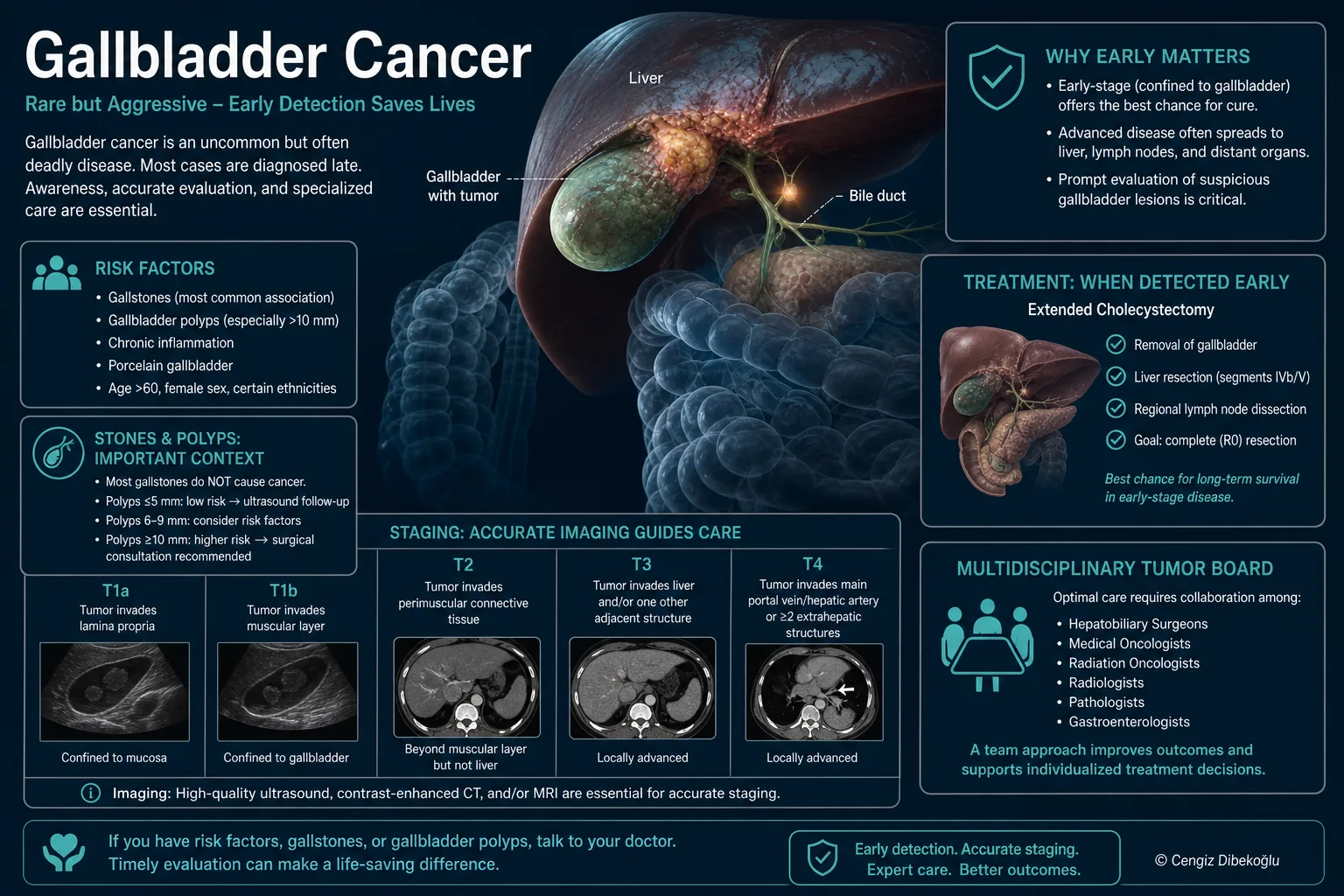
3D educational illustration: biliary tract and gallbladder anatomy

How did treatment change?

In biliary tract cancers, advanced systemic therapy and molecular targets have moved beyond a “single chemotherapy” era.

  1. Previous approach

    In advanced disease, regimens such as gemcitabine–cisplatin were the main option; molecular separation was limited.

  2. New clinical evidence

    Immune-addition studies such as TOPAZ-1 and FGFR / IDH-targeted options diversified the sequence.

  3. Current approach

    Surgery, adjuvant therapy, and advanced systemic / targeted treatment are planned by location, resectability, and molecular profile.

This summary is for patient education; individual treatment decisions depend on stage, pathology, imaging, and physician assessment.

Landmark status

Sorting

Topic filters

Showing 15 studies.

Comparison table

Select 2 or 3 studies to compare. Different endpoints are never combined in one chart.

Biliary tract / gallbladder · postoperative

Foundational Evidence2019Source verified

BILCAP

What did the researchers want to learn?

In biliary tract or gallbladder cancer removed by surgery, does oral capecitabine prolong survival?

Before

After curative resection, a routine adjuvant standard was uncertain for many patients / observation was common.

Today

In suitable patients, adjuvant capecitabine became one of the widely used reference options; the ITT uncertainty is stated openly.

What did this study change?

Adjuvant capecitabine became an option in suitable patients; the ITT uncertainty is stated openly.

Benefit for patients

Relevant to the adjuvant capecitabine decision in surgically removed biliary tract cancer.

What did the research find?

The primary intention-to-treat (ITT) analysis did not reach statistical significance; per-protocol, sensitivity and long-term analyses provide support in favor of capecitabine. ITT / per-protocol (PP) / sensitivity analyses are read separately.

Who does this apply to?

The same benefit in all patients, or superiority over all other adjuvant treatments, has not been proven. The gallbladder cancer (GBC) subgroup is not an independent superiority claim.

What did it not prove?

The study did not prove the same degree of benefit in all patients, or that capecitabine is superior to all other adjuvant treatments.

This summary is not a treatment recommendation. Decisions depend on the type of disease, stage, general health, and your physician's assessment.

Extrahepatic bile duct cancer · gemcitabine after surgery

Emerging Evidence2018Source verified

BCAT

What did the researchers want to learn?

In cancers of the part of the bile duct outside the liver that have been operated on, does gemcitabine after surgery prolong survival or the time before the cancer comes back?

Before

Adjuvant gemcitabine was being studied in biliary cancer.

Today

The expected benefit was not clarified in this study; it is read together with BILCAP.

What did this study change?

It did not support routine use of gemcitabine alone after surgery.

Benefit for patients

Relevant to patients with resected biliary cancer.

What did the research find?

No significant superiority could be shown in survival or in the time before the cancer came back; that is, the main goal of the study was not met.

Who does this apply to?

The study focuses on extrahepatic bile duct cancers; it should not be equated with all bile duct cancers.

What did it not prove?

Does not prove that capecitabine is ineffective.

This summary is not a treatment recommendation. Decisions depend on the type of disease, stage, general health, and your physician's assessment.

Operated biliary tract cancer · GEMOX after surgery

Emerging Evidence2019Source verified

PRODIGE-12 / ACCORD-18

What did the researchers want to learn?

After biliary tract cancer surgery, does GEMOX chemotherapy prolong the time before the cancer comes back or survival?

Before

Adjuvant gemcitabine–oxaliplatin was under discussion.

Today

Routine adjuvant superiority of GEMOX was not shown.

What did this study change?

It did not support GEMOX being used as standard treatment after surgery.

Benefit for patients

Relevant to patients with resected biliary cancer.

What did the research find?

No statistically significant superiority could be shown in the time before the cancer came back or in survival; that is, the main goal of the study was not met.

Who does this apply to?

It is not a regimen-for-regimen comparison with the BILCAP or ASCOT studies; the results therefore cannot be compared directly with those studies.

What did it not prove?

Does not cancel the BILCAP capecitabine pathwmo.

This summary is not a treatment recommendation. Decisions depend on the type of disease, stage, general health, and your physician's assessment.

Operated biliary tract / gallbladder cancer · S-1 after surgery

Foundational Evidence2023 primer → 2026 5ySource verified

ASCOT / JCOG1202

What did the researchers want to learn?

In operated bile duct and gallbladder cancers, does S-1 after surgery prolong survival compared with observation alone?

Before

Adjuvant S-1 was studied in an Asian biliary population.

Today

Adjuvant S-1 mmo be supported in a selected population; geographic context matters.

What did this study change?

It showed a survival benefit for S-1 after surgery; these data come from Japanese patients.

Benefit for patients

Relevant to patients with resected biliary cancer.

What did the research find?

In the first analysis, the three-year survival rate was 77.1% and 67.6% (hazard ratio 0.69). In the current 2026 five-year analysis, the rates were 64% and 52% (hazard ratio 0.72).

Who does this apply to?

The Japanese patient group, access to S-1 and regional practice must be taken into account. It is not a regimen-for-regimen comparison with the BILCAP study.

What did it not prove?

Does not mean it is automatically equivalent to the Western BILCAP population.

This summary is not a treatment recommendation. Decisions depend on the type of disease, stage, general health, and your physician's assessment.

Open this discovery in the “Discoveries That Changed Cancer Treatment” hub

Biliary tract / gallbladder cancer · advanced stage

Gold Star — Paradigm-Changing2010Source verified

ABC-02

What did the researchers want to learn?

In advanced biliary tract cancer, does giving gemcitabine together with cisplatin prolong survival compared with gemcitabine alone?

Before

Single-agent gemcitabine was commonly used in advanced biliary cancer.

Today

GemCis became the backbone 1L chemotherapy in advanced / unresectable biliary cancer.

What did this study change?

In advanced biliary cancers, the gemcitabine–cisplatin combination became the basic chemotherapy standard; later immunotherapy studies were built on this foundation.

Benefit for patients

Relevant to the first-line GemCis decision in advanced/metastatic biliary cancer.

What did the research find?

Median overall survival (OS) was 11.7 vs 8.1 months (hazard ratio [HR] 0.64). It cannot be applied directly to adjuvant (postoperative) treatment.

Who does this apply to?

For advanced / unresectable biliary cancer. It should not be confused with postoperative adjuvant decisions.

What did it not prove?

These results cannot be applied directly to postoperative adjuvant treatment.

This summary is not a treatment recommendation. Decisions depend on the type of disease, stage, general health, and your physician's assessment.

Why this study has a gold star: Made GemCis the backbone chemotherapy regimen in advanced biliary cancers. (2010 / editorial 2026-11)

Biliary tract cancer · advanced-stage first-line

Foundational Evidence2022 → updated OSSource verified

TOPAZ-1

What did the researchers want to learn?

In advanced biliary tract cancer, does adding durvalumab to chemotherapy prolong survival?

Before

In advanced biliary cancer, 1L backbone was GemCis; routine IO was not used.

Today

In suitable patients, durvalumab + GemCis became one of the 1L options (US FDA 2022).

What did this study change?

Immunotherapy plus chemotherapy became one of the first-line options for suitable patients.

Benefit for patients

Relevant to the decision to add durvalumab to GemCis in advanced biliary cancer.

What did the research find?

Adding durvalumab to GemCis (gemcitabine plus cisplatin) improved overall survival (OS) (interim analysis and updated OS are separate). Immunotherapy is not mandatory for all early-stage / resected patients.

Who does this apply to?

No head-to-head superiority claim can be made versus KEYNOTE-966 (different agent / protocol).

What did it not prove?

This study did not show that immunotherapy should be given in all early-stage and completely surgically removed bile-duct cancers.

This summary is not a treatment recommendation. Decisions depend on the type of disease, stage, general health, and your physician's assessment.

Advanced biliary tract cancer · first-line pembrolizumab + gemcitabine-cisplatin

Foundational Evidence2023Source verified

KEYNOTE-966

What did the researchers want to learn?

In previously untreated advanced biliary tract cancer, does adding pembrolizumab to gemcitabine-cisplatin chemotherapy prolong survival?

Before

Pre–GemCis ± IO era; no pembrolizumab 1L BTC approval.

Today

In suitable patients, pembrolizumab + GemCis became one of the 1L options (US FDA 2023).

What did this study change?

It broadened first-line immunotherapy options in advanced biliary tract cancer.

Benefit for patients

Relevant to the pembrolizumab + chemotherapy option in advanced biliary cancer.

What did the research find?

Median overall survival (OS) 12.7 vs 10.9 months (hazard ratio [HR] 0.83). It has not been proven that pembrolizumab is superior to durvalumab (not a head-to-head study).

Who does this apply to?

A different agent / protocol from TOPAZ-1; there is no direct comparison. The gallbladder cancer (GBC) subgroup is not an independent superiority claim.

What did it not prove?

KEYNOTE-966 is not a direct comparative study proving that pembrolizumab is superior to durvalumab.

This summary is not a treatment recommendation. Decisions depend on the type of disease, stage, general health, and your physician's assessment.

Advanced biliary tract cancer · second-line FOLFOX

Foundational Evidence2021Source verified

ABC-06

What did the researchers want to learn?

In biliary tract cancer that has progressed after first chemotherapy (gemcitabine-cisplatin), does second-line FOLFOX prolong survival compared with supportive care alone?

Before

Randomized OS evidence in the 2L setting after GemCis was limited; active symptom control was common.

Today

In suitable patients, 2L FOLFOX was strengthened as an option.

What did this study change?

It provided randomized survival evidence for FOLFOX in the second line.

Benefit for patients

Relevant to the second-line FOLFOX decision in advanced biliary cancer.

What did the research find?

Median overall survival (OS) 6.2 vs 5.3 months (hazard ratio [HR] 0.69). It has not been shown that every patient should receive second-line FOLFOX.

Who does this apply to?

General condition, previous treatments and molecular features are important.

What did it not prove?

This study does not show that every patient should receive FOLFOX in the second line. Performance status, prior treatments, and molecular features matter.

This summary is not a treatment recommendation. Decisions depend on the type of disease, stage, general health, and your physician's assessment.

IDH1-mutant advanced biliary tract cancer · ivosidenib

Emerging Evidence2020Source verified

ClarIDHy

What did the researchers want to learn?

In advanced biliary tract cancer with an IDH1 gene alteration, does ivosidenib prolong the time before the disease progresses?

Before

Targeted options in IDH1-mutant cholangiocarcinoma were limited.

Today

Ivosidenib became an option in selected IDH1-mutant patients.

What did this study change?

It showed that the IDH1 mutation can be used in treatment selection.

Benefit for patients

Relevant to patients with IDH1-mutant advanced cholangiocarcinoma.

What did the research find?

Median progression-free survival (time before the disease progressed) was 2.7 months and 1.4 months (hazard ratio 0.37). Because patients crossed over from the control group to treatment, it is difficult to interpret overall survival.

Who does this apply to?

Crossover makes the interpretation of survival difficult. IDH1 alterations are not seen with the same frequency in all biliary tract cancers; it applies only to patients who test positive.

What did it not prove?

Not generalizable to IDH1 wild type.

This summary is not a treatment recommendation. Decisions depend on the type of disease, stage, general health, and your physician's assessment.

Advanced biliary tract cancer with an FGFR2 alteration · pemigatinib

Emerging Evidence2020Source verified

FIGHT-202

What did the researchers want to learn?

In previously treated advanced biliary tract cancer with an FGFR2 gene fusion or rearrangement, does pemigatinib shrink the tumor?

Before

Targeted therapy in FGFR2 fusion-positive cholangiocarcinoma was evolving.

Today

Pemigatinib became an option in selected FGFR2 fusion/rearrangement patients.

What did this study change?

It showed the clinical importance of FGFR2 molecular testing.

Benefit for patients

Relevant to patients with FGFR2-altered advanced cholangiocarcinoma.

What did the research find?

In the subgroup with an FGFR2 alteration, the tumor shrinkage (response) rate was found to be about 35.5%. There is no comparison group.

Who does this apply to?

It is a single-arm study without a comparison group; a survival advantage over standard chemotherapy has not been shown. Valid only for patients with an FGFR2 alteration.

What did it not prove?

Not transferable to FGFR-negative disease.

This summary is not a treatment recommendation. Decisions depend on the type of disease, stage, general health, and your physician's assessment.

Advanced biliary tract cancer with an FGFR2 alteration · futibatinib

Emerging Evidence2022Source verified

FOENIX-CCA2

What did the researchers want to learn?

In advanced biliary tract cancer with an FGFR2 gene fusion or rearrangement, does futibatinib shrink the tumor?

Before

Other FGFR inhibitors were being studied.

Today

Futibatinib provided an option in selected FGFR2 fusion-positive patients.

What did this study change?

It broadened FGFR2-targeted treatment options.

Benefit for patients

Relevant to patients with FGFR2 fusion-positive cholangiocarcinoma.

What did the research find?

The tumor shrinkage (response) rate was 42%, and the median duration of response was about 9.7 months.

Who does this apply to?

It is a single-arm study without a comparison group and covers a selected molecular patient group; a survival advantage has not been shown.

What did it not prove?

Does not prove the same effect across all FGFR alterations.

This summary is not a treatment recommendation. Decisions depend on the type of disease, stage, general health, and your physician's assessment.

Advanced biliary tract cancer with an FGFR2 alteration · lirafugratinib

Emerging Evidence2026Source verified

ReFocus

What did the researchers want to learn?

In advanced biliary tract cancer with an FGFR2 alteration, previously treated with at least one therapy and not treated with an FGFR inhibitor, does lirafugratinib produce confirmed tumor shrinkage?

Before

FGFR inhibitor comparisons/sequencing were unclear.

Today

The study provides additional evidence in the FGFR-targeted space; selection depends on the molecular profile.

What did this study change?

In selected patients not treated with an FGFR inhibitor, it provided single-arm efficacy evidence for a new-generation FGFR2-targeted option.

Benefit for patients

Relevant to patients with FGFR-altered biliary cancer.

What did the research find?

On independent review, in the main efficacy group (114 patients), a tumor shrinkage rate of 46.5%, a median duration of response of 11.8 months, a median progression-free survival of 11.3 months and a median survival of 22.8 months were reported. Because there is no comparison group, this does not mean a survival advantage.

Who does this apply to?

It is a single-arm study; there is no randomized survival comparison against standard treatment. Molecular eligibility is required; access and licensing may vary by country.

What did it not prove?

Does not by itself change the first-line chemotherapy+IO standard.

This summary is not a treatment recommendation. Decisions depend on the type of disease, stage, general health, and your physician's assessment.

HER2-positive advanced biliary tract cancer · zanidatamab

Emerging Evidence2023Source verified

HERIZON-BTC-01

What did the researchers want to learn?

In previously treated HER2-positive advanced biliary tract cancer, does zanidatamab shrink the tumor?

Before

Targeted therapy in HER2+ biliary cancer was limited.

Today

Zanidatamab showed promise in selected HER2+ patients.

What did this study change?

It showed the importance of HER2-targeted therapy in biliary tract cancer.

Benefit for patients

Relevant to patients with HER2-positive advanced biliary cancer.

What did the research find?

In the main efficacy group with HER2 immunohistochemistry (IHC) 2+/3+ and gene amplification, a confirmed tumor shrinkage rate of 41.3% was found.

Who does this apply to?

HER2 protein and gene status are important. Because it is a single-arm study, it does not mean a randomized survival advantage.

What did it not prove?

Not generalizable to HER2-negative disease.

This summary is not a treatment recommendation. Decisions depend on the type of disease, stage, general health, and your physician's assessment.

HER2-positive advanced biliary tract cancer · tucatinib + trastuzumab

Emerging Evidence2023Source verified

SGNTUC-019

What did the researchers want to learn?

In HER2-positive advanced biliary tract cancer, do tucatinib and trastuzumab together shrink the tumor?

Before

Other HER2-targeted combinations were being studied.

Today

Tucatinib-based approaches are considered in selected HER2+ patients.

What did this study change?

It supported the investigation of HER2-targeted combinations in this disease.

Benefit for patients

Relevant to patients with HER2-positive biliary cancer.

What did the research find?

In the biliary tract group evaluated, a tumor shrinkage rate of about 46.7% was found.

Who does this apply to?

There is no randomized comparison; access to the drug and licensing vary by country. Valid only for selected HER2-positive patients.

What did it not prove?

Does not prove replacement of standard GemCis+IO.

This summary is not a treatment recommendation. Decisions depend on the type of disease, stage, general health, and your physician's assessment.

Operated biliary tract / gallbladder cancer · gemcitabine-cisplatin versus capecitabine after surgery

Emerging Evidence2026Source verified

ACTICCA-1

What did the researchers want to learn?

Does gemcitabine-cisplatin chemotherapy after surgery prolong the time before the cancer comes back compared with capecitabine?

Before

Adjuvant GemCis was being studied in biliary cancer.

Today

Superiority of adjuvant GemCis over capecitabine was not clarified; the BILCAP context is preserved.

What did this study change?

It did not make gemcitabine-cisplatin the standard treatment after surgery; it could not show a proven superiority over capecitabine.

Benefit for patients

Relevant to patients with resected biliary cancer.

What did the research find?

In the 2026 final analysis, the median time before the cancer came back was 25.7 months with gemcitabine-cisplatin and 17.9 months with capecitabine; however, the statistical difference was not significant (p=0.097), that is, the main goal of the study was not met. Survival did not improve significantly, and gemcitabine-cisplatin had more side effects.

Who does this apply to?

Additional analyses were performed because the proportional hazards assumption was violated; these do not replace the main analysis. Subgroup signals are exploratory.

What did it not prove?

Does not make the metastatic ABC-02 regimen an adjuvant mandate.

This summary is not a treatment recommendation. Decisions depend on the type of disease, stage, general health, and your physician's assessment.

Atlas comparison guide

BILCAP — ITT or per-protocol?

Primary ITT OS HR 0.81 (p=0.097) was negative. Per-protocol HR 0.75; long-term ITT HR 0.84; protocol sensitivity HR 0.74. The three analyses are read separately; ITT negativity is not concealed.

ASCOT vs BILCAP

ASCOT is Japanese S-1 data (5y OS 64% vs 52% in 2026). Not a head-to-head regimen comparison with BILCAP.

TOPAZ-1 vs KEYNOTE-966

Both are GemCis + IO, but agents and maintenance/protocol durations differ. No head-to-head superiority or indirect ranking.

Gallbladder cancer (GBC) subgroups

BILCAP, ABC-02, TOPAZ-1, and KEYNOTE-966 included GBC together with other BTC. Long-term BILCAP did not report a clear interaction by disease site; that is not independent superiority evidence for GBC. If the subgroup is inadequate, no independent claim is made.

Molecular cards

ClarIDHy (IDH1), FIGHT-202 / FOENIX / ReFocus (FGFR2), HERIZON / SGNTUC (HER2) are interpreted only in the appropriate molecular subgroup. ORR ≠ randomized OS.

ACTICCA-1

In the 2026 final analysis, primary DFS log-rank was not significant; adjuvant GemCis was not recommended as standard.

Surgery / incidental GBC

T1b is individualized. Surgical boxes are not RCT cards; they are not mixed with systemic OS/ORR. HCC / cholangiocarcinoma / GBC are separate disease groups.

Medical editor's note

Each study was designed for a specific patient group, treatment arm, and primary endpoint. Results should not be automatically generalized to other diseases or to all patients. This atlas is educational and is not a treatment recommendation.

Evidence

Scientific sources

Show sources · 6

Biliary landmark atlas: BILCAP (ITT≠PP), ASCOT 2026, ABC-02, TOPAZ-1, KEYNOTE-966, ABC-06, ClarIDHy, FIGHT-202, FOENIX-CCA2, ReFocus, HERIZON-BTC-01, SGNTUC-019, ACTICCA-1. Preserve iCCA/pCCA/dCCA/GBC and ORR≠OS distinctions.

  1. Biliary tract cancer: ESMO Clinical Practice Guideline for diagnosis, treatment and follow-upESMO · 2023 / livingOpen source
  2. NCCN Clinical Practice Guidelines in Oncology: Biliary Tract CancersNCCN · Current versionOpen source
  3. Capecitabine compared with observation in resected biliary tract cancer (BILCAP)The Lancet Oncology · 2019 · DOI: 10.1016/S1470-2045(18)30915-XOpen source
  4. Durvalumab or placebo plus gemcitabine and cisplatin in advanced biliary tract cancer (TOPAZ-1): updated overall survivalThe Lancet Gastroenterology & Hepatology · 2024Open source
  5. Five-Year Follow-Up of the Phase III ASCOT Trial of Adjuvant S-1 After Resection for Biliary Tract CancerJournal of Clinical Oncology · 2026 · DOI: 10.1200/JCO-26-00017Open source
  6. ESMO Gastrointestinal Cancer GuidelinesESMO · Living / eUpdateOpen source

Source list last checked: 31 October 2026. (Page content review date may appear separately above.)