Disease-specific landmark atlas · GIST

GIST Landmark Atlas

Surgery, mutation testing, and tyrosine kinase inhibitors in GIST, including adjuvant imatinib trials (B2222, Z9001, SSGXVIII/AIO), GRID, INVICTUS, and NAVIGATOR.

DFS, OS, pCR, cCR, and similar endpoints are not interchangeable. Gold stars are never assigned automatically. Numeric cards are verified summaries of primary publications. A patient summary is not a treatment recommendation.

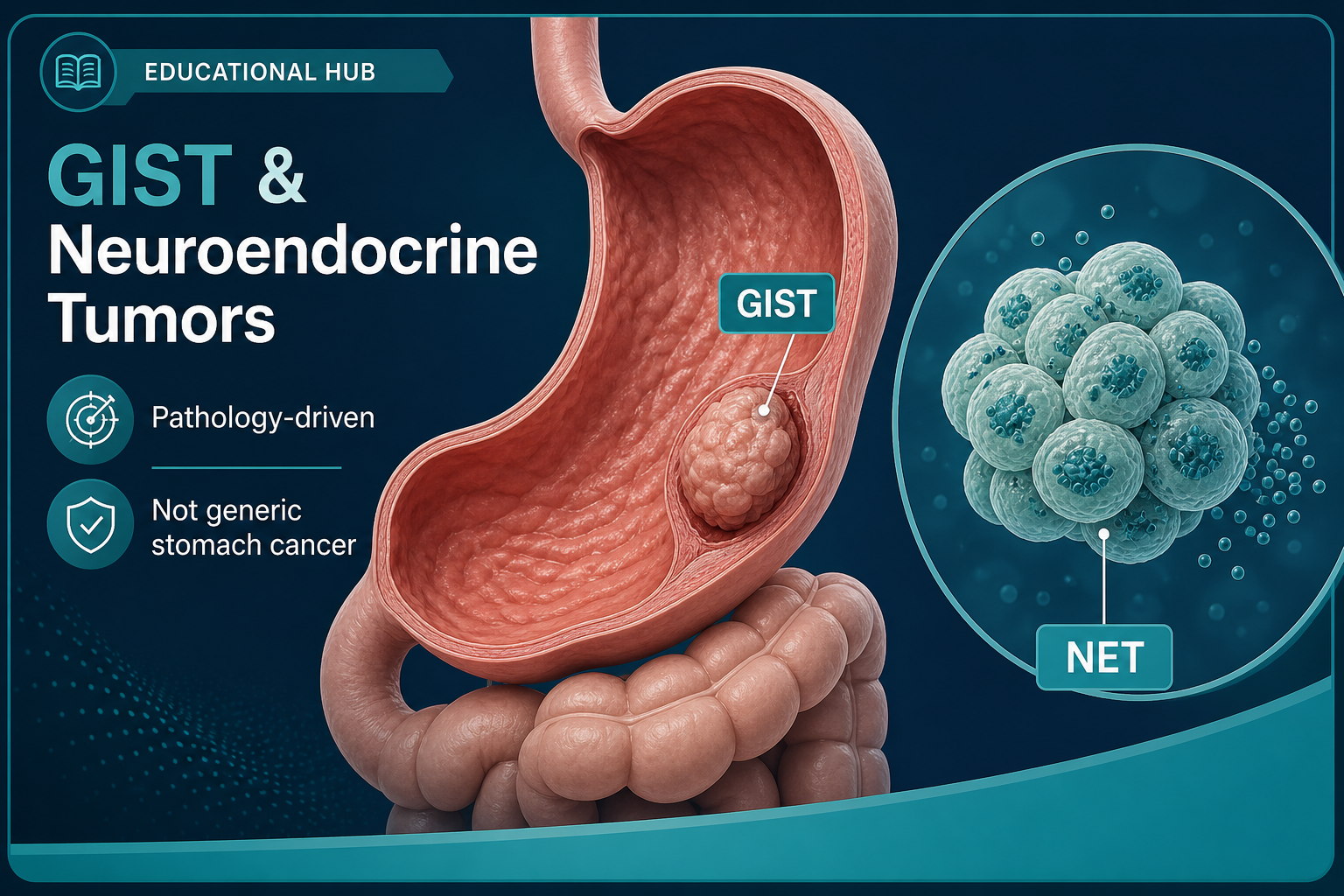
3D educational illustration: GIST and neuroendocrine tumor context

How did treatment change?

In GIST, imatinib and later TKI lines have transformed postoperative and advanced-disease management.

  1. Previous approach

    Systemic options were limited; treatment relied largely on surgery.

  2. New clinical evidence

    Adjuvant / advanced imatinib studies and lines such as sunitinib, regorafenib, and ripretinib strengthened selection by mutation and risk.

  3. Current approach

    Surgery and TKI sequencing are planned together by KIT / PDGFRA mutation, risk score, and resectability.

This summary is for patient education; individual treatment decisions depend on stage, pathology, imaging, and physician assessment.

Landmark status

Sorting

Topic filters

Showing 12 studies.

Comparison table

Select 2 or 3 studies to compare. Different endpoints are never combined in one chart.

Open this discovery in the “Discoveries That Changed Cancer Treatment” hub

Advanced / metastatic GIST · imatinib

Gold Star — Paradigm-Changing2002Source verified

B2222

What did the researchers want to learn?

In advanced GIST (gastrointestinal stromal tumor), can imatinib control the tumor?

Before

Effective systemic options in advanced GIST were very limited.

Today

Imatinib became established as first-line targeted therapy.

What did this study change?

Imatinib became the core systemic option in advanced GIST.

Benefit for patients

Potential for tumor control and reduction of symptom / disease burden.

What did the research find?

Marked shrinkage (partial response) was seen in roughly one in every two patients; in addition, in some the disease remained stable.

Who does this apply to?

Advanced GIST. The mutation subtype (especially PDGFRA D842V) is read separately.

What did it not prove?

Adjuvant duration. Mandatory imatinib in PDGFRA D842V. The same response across every mutation.

Evidence status: Current — foundational study that launched the imatinib era

This summary is not a treatment recommendation. Decisions depend on the type of disease, stage, general health, and your physician's assessment.

Why this study has a gold star: Paradigmatic evidence that brought targeted therapy with imatinib into clinical practice for advanced GIST. (2002 NEJM · editorial approval 2026-10-29)

Open this discovery in the “Discoveries That Changed Cancer Treatment” hub

Localized GIST · adjuvant imatinib

Gold Star — Paradigm-Changing2009Source verified

ACOSOG Z9001

What did the researchers want to learn?

Does imatinib after surgery reduce recurrence?

Before

Adjuvant TKI was not routine.

Today

Adjuvant imatinib was proven for RFS; the duration debate continued.

What did this study change?

Adjuvant imatinib became something discussed in selected localized GIST.

Benefit for patients

Reduced early recurrence risk.

What did the research find?

The one-year recurrence-free rate was about 98% in the imatinib arm and 83% with placebo.

Who does this apply to?

Resected KIT-positive GIST. Duration and risk group are updated according to SSGXVIII / guidelines.

What did it not prove?

Mandatory adjuvant imatinib for everyone. A 3-year duration. OS superiority (early analysis).

Evidence status: Current — adjuvant RFS; duration read with SSGXVIII

This summary is not a treatment recommendation. Decisions depend on the type of disease, stage, general health, and your physician's assessment.

Why this study has a gold star: Pivotal RCT showing adjuvant imatinib RFS benefit; the 3-year duration was strengthened by SSGXVIII. (2009 Lancet · editorial approval 2026-10-29)

Open this discovery in the “Discoveries That Changed Cancer Treatment” hub

High-risk GIST · adjuvant duration

Gold Star — Paradigm-Changing2012 / 2020Source verified

SSGXVIII/AIO

What did the researchers want to learn?

In high risk, should imatinib be given for 3 years or 1 year?

Before

Adjuvant duration was often 1 year in many settings.

Today

3 years was strengthened for high-risk disease.

What did this study change?

In high risk, 3 years of adjuvant imatinib became the widely used reference duration.

Benefit for patients

Potential for a longer recurrence-free interval and long-term survival gain.

What did the research find?

Three years of treatment improved recurrence-free and overall survival compared with one year (5-year and 10-year analyses).

Who does this apply to?

High-risk resected GIST. Extension to 6 years is IMADGIST (disease-free survival [DFS]; overall survival [OS] not mature).

What did it not prove?

Mandatory 3 years for everyone. 6-year OS superiority. The same benefit across the full mutation spectrum.

Evidence status: Current — high-risk 3 years; 10y OS update

This summary is not a treatment recommendation. Decisions depend on the type of disease, stage, general health, and your physician's assessment.

Why this study has a gold star: RCT supporting the foundational 3-year adjuvant imatinib duration standard in high-risk localized GIST. (2012/2020 · editorial approval 2026-10-29)

Localized GIST · adjuvant 2 years

Foundational Evidence2015 / 2021Source verified

EORTC 62024

What did the researchers want to learn?

Is 2 years of imatinib after surgery better than observation?

Before

Adjuvant duration was uncertain.

Today

There is an RFS signal; primary IFFS is negative — together with SSGXVIII.

What did this study change?

It contributed to the adjuvant discussion; SSGXVIII takes priority for the duration standard.

Benefit for patients

Reduced recurrence risk (RFS); an OS guarantee is not claimed on this card.

What did the research find?

A reduction in recurrence was seen; the main long-term endpoint (imatinib failure-free survival, IFFS) and overall survival (OS) did not show significant superiority.

Who does this apply to?

High / intermediate risk. The 3-year SSGXVIII is separate.

What did it not prove?

IFFS/OS superiority. A 3-year duration.

Evidence status: Foundational context — primary IFFS negative; RFS positive

This summary is not a treatment recommendation. Decisions depend on the type of disease, stage, general health, and your physician's assessment.

High-risk GIST · 6 vs 3 years

Under review for paradigm-changing status2024Source verified

IMADGIST

What did the researchers want to learn?

In high risk, should imatinib be extended to 6 years?

Before

Duration after 3 years in high-risk disease was uncertain.

Today

6 years is an option for DFS; OS/selection is individualized.

What did this study change?

Extension is discussed in selected patients; it is not presented as 6 years routinely for everyone.

Benefit for patients

Longer disease-free interval in selected patients.

What did the research find?

Six years reduced the return of the disease compared with three years; the difference in overall survival is not clear at this follow-up.

Who does this apply to?

Recurrence risk ≥35% + 3 years completed. Maturity of overall survival (OS) is awaited.

What did it not prove?

OS superiority. Mandatory 6 years for every high-risk patient.

Evidence status: DFS positive — OS not mature; under star review

Gold-star candidate — awaiting editorial review: Under review — strong DFS; OS immature; relationship to SSGXVIII must be stated clearly. Stars are never assigned automatically.

This summary is not a treatment recommendation. Decisions depend on the type of disease, stage, general health, and your physician's assessment.

Open this discovery in the “Discoveries That Changed Cancer Treatment” hub

Advanced GIST · stopping imatinib

Gold Star — Paradigm-Changing2007 / 2024Source verified

BFR14

What did the researchers want to learn?

In advanced GIST, can imatinib be stopped?

Before

Interruption after response was tried in some centers.

Today

Arbitrary interruption worsens PFS — a cautious approach.

What did this study change?

Routine discontinuation is not recommended in the absence of progression (individual toxicity / decisions are separate).

Benefit for patients

Avoidance of early progression.

What did the research find?

Stopping while the disease was under control led to faster progression of the disease than continuing.

Who does this apply to?

Advanced / metastatic controlled disease. It is not adjuvant.

What did it not prove?

Adjuvant duration policy. Mandatory lifelong therapy in every scenario.

Evidence status: Current — interruption worsens PFS

This summary is not a treatment recommendation. Decisions depend on the type of disease, stage, general health, and your physician's assessment.

Why this study has a gold star: Practical rule-setting study showing that interrupting imatinib without progression worsens PFS in advanced GIST. (2007/2024 · editorial approval 2026-10-29)

Advanced GIST · imatinib dose

Foundational Evidence2004Source verified

EORTC 62005

What did the researchers want to learn?

Should imatinib be 400 or 800?

Before

Dose was often empirical.

Today

Mutation (exon 9) influences dose decisions.

What did this study change?

The role of mutation information in the dose decision was strengthened.

Benefit for patients

Potential for longer control with correct dose / mutation matching.

What did the research find?

Treatment is generally started at 400 mg; in KIT exon 9 mutation, a higher dose has been shown to delay progression.

Who does this apply to?

Advanced GIST. KIT exon 9 is not the same as PDGFRA D842V.

What did it not prove?

Mandatory 800 mg in PDGFRA D842V. Adjuvant dosing.

Evidence status: Foundational — dose + exon 9 framework

This summary is not a treatment recommendation. Decisions depend on the type of disease, stage, general health, and your physician's assessment.

Open this discovery in the “Discoveries That Changed Cancer Treatment” hub

Advanced GIST · second-line sunitinib

Gold Star — Paradigm-Changing2006Source verified

Sunitinib faz III

What did the researchers want to learn?

Is sunitinib beneficial after imatinib?

Before

Options after imatinib were limited.

Today

Sunitinib became a second-line option.

What did this study change?

Second-line sunitinib became established.

Benefit for patients

Delayed progression.

What did the research find?

Progression-free survival was clearly prolonged with sunitinib (about 27 vs 6 weeks).

Who does this apply to?

Advanced disease after imatinib. It is not the same as adjuvant imatinib. Mutation subtype affects toxicity / response.

What did it not prove?

An adjuvant role. Superiority over ripretinib (INTRIGUE separate). A first-line role.

Evidence status: Current — second-line sunitinib

This summary is not a treatment recommendation. Decisions depend on the type of disease, stage, general health, and your physician's assessment.

Why this study has a gold star: Evidence for second-line sunitinib after imatinib. (2006 Lancet · editorial approval 2026-10-29)

Advanced GIST · third-line regorafenib

Clinical Milestone2013Source verified

GRID

What did the researchers want to learn?

Does regorafenib work in the third line?

Before

3L options were limited.

Today

Regorafenib became a 3L option.

What did this study change?

Third-line regorafenib became established as an option.

Benefit for patients

Delayed progression.

What did the research find?

Progression-free survival was about 4.8 months vs 0.9 months.

Who does this apply to?

After imatinib + sunitinib. It is not adjuvant treatment.

What did it not prove?

The 4L ripretinib question. 2L superiority. A fundamental paradigm shift. Does not claim OS superiority in this summary.

Evidence status: Current — 3L regorafenib (milestone)

This summary is not a treatment recommendation. Decisions depend on the type of disease, stage, general health, and your physician's assessment.

Open this discovery in the “Discoveries That Changed Cancer Treatment” hub

Advanced GIST · fourth-line or later ripretinib

Gold Star — Paradigm-Changing2020Source verified

INVICTUS

What did the researchers want to learn?

Is ripretinib beneficial in the fourth line?

Before

After several tyrosine kinase inhibitors (for example imatinib, sunitinib, regorafenib), effective randomized options for progressing GIST were very limited.

Today

In suitable patients after at least three TKIs, ripretinib became an option that prolongs progression-free survival in fourth line and beyond. Superiority over sunitinib in the second line is not this study’s question.

What did this study change?

Ripretinib in the fourth line or later became established as an option.

Benefit for patients

In patients progressing after multiple drugs, time to further worsening (PFS) may be markedly prolonged; this does not mean the same response or a survival guarantee for every patient.

What did the research find?

Progression-free survival was about 6.3 months vs 1 month.

Who does this apply to?

At least 3 prior tyrosine kinase inhibitors (TKIs). The second-line INTRIGUE study is separate.

What did it not prove?

Superiority over sunitinib in 2L. A fundamental paradigm shift.

Evidence status: Current — ≥4L ripretinib (overlay: paradigm / gold star)

This summary is not a treatment recommendation. Decisions depend on the type of disease, stage, general health, and your physician's assessment.

Why this study has a gold star: Ripretinib as a ≥4L option after multiple TKIs (clinical milestone). (2020 Lancet Oncol · gold star retained 2026-10-29)

Advanced GIST · second-line ripretinib vs sunitinib

Foundational Evidence2022Source verified

INTRIGUE

What did the researchers want to learn?

In the second line, is ripretinib better than sunitinib?

Before

Whether ripretinib would outperform sunitinib in 2L was unknown.

Today

No primary PFS superiority — choice is individualized.

What did this study change?

No automatic ripretinib superiority emerges in the choice of second line; the evidence for sunitinib is preserved.

Benefit for patients

Realistic expectation; avoidance of an unnecessary “newer = better” assumption.

What did the research find?

Superiority was not shown in progression-free survival, the main goal; the times were similar.

Who does this apply to?

Second line after imatinib. The fourth-line INVICTUS study is separate. There is no primary progression-free survival (PFS) superiority.

What did it not prove?

2L PFS superiority. Cancellation of the 4L INVICTUS result.

Evidence status: Negative primary PFS — no paradigm claim

This summary is not a treatment recommendation. Decisions depend on the type of disease, stage, general health, and your physician's assessment.

Do these trials ask the same question?

SSGXVIII – IMADGIST

SSGXVIII shows 3 years superior to 1 year in high risk. IMADGIST asks whether extending beyond 3 years to 6 years benefits DFS; OS is not mature. They are not interchangeable.

KIT – PDGFRA D842V

Separate molecular niches. Imatinib sensitivity is not assumed in D842V; NAVIGATOR avapritinib is single-arm ORR.

Sunitinib phase III – INTRIGUE – INVICTUS

Sunitinib superior to placebo in 2L. INTRIGUE: no ripretinib superiority in 2L. INVICTUS: ripretinib superior to placebo in ≥4L. Lines are not mixed.

B2222 – BFR14

B2222 opens the imatinib era; BFR14 shows that interrupting therapy in progression-free disease worsens PFS.

EORTC 62024 – SSGXVIII

62024 did not meet its primary IFFS endpoint (RFS benefit present). SSGXVIII takes priority for the duration standard.

Medical editor's note

Each study was designed for a specific patient group, treatment arm, and primary endpoint. Results should not be automatically generalized to other diseases or to all patients. This atlas is educational and is not a treatment recommendation.

Evidence

Scientific sources

Show sources · 3

GIST landmark atlas: B2222, Z9001, SSGXVIII/AIO, EORTC 62024, IMADGIST, BFR14, EORTC 62005, sunitinib, GRID, INVICTUS, NAVIGATOR (PDGFRA D842V single-arm), INTRIGUE (2L PFS superiority not met). KIT≠PDGFRA; RFS/DFS/PFS/OS not interchangeable. No automatic gold stars.

  1. NCCN Guidelines — Gastrointestinal Stromal Tumors (GIST)NCCN · Current versionOpen source
  2. SSGXVIII/AIO — Three versus one year of adjuvant imatinib for high-risk GIST (10-year update)JAMA Oncology (clinical study; not a guideline) · 2020 · DOI: 10.1001/jamaoncol.2020.2091Open source
  3. ESMO Gastrointestinal Cancer GuidelinesESMO · Living / eUpdateOpen source

Source list last checked: 31 October 2026. (Page content review date may appear separately above.)