Disease-specific landmark atlas · Rectum

Rectal Cancer Landmark Atlas

Landmark studies on total neoadjuvant therapy (TNT), organ preservation, selective radiotherapy, dMMR/MSI-H immunotherapy, and surgical technique.

DFS, OS, pCR, cCR, and similar endpoints are not interchangeable. Gold stars are never assigned automatically. Numeric cards are verified summaries of primary publications. A patient summary is not a treatment recommendation.

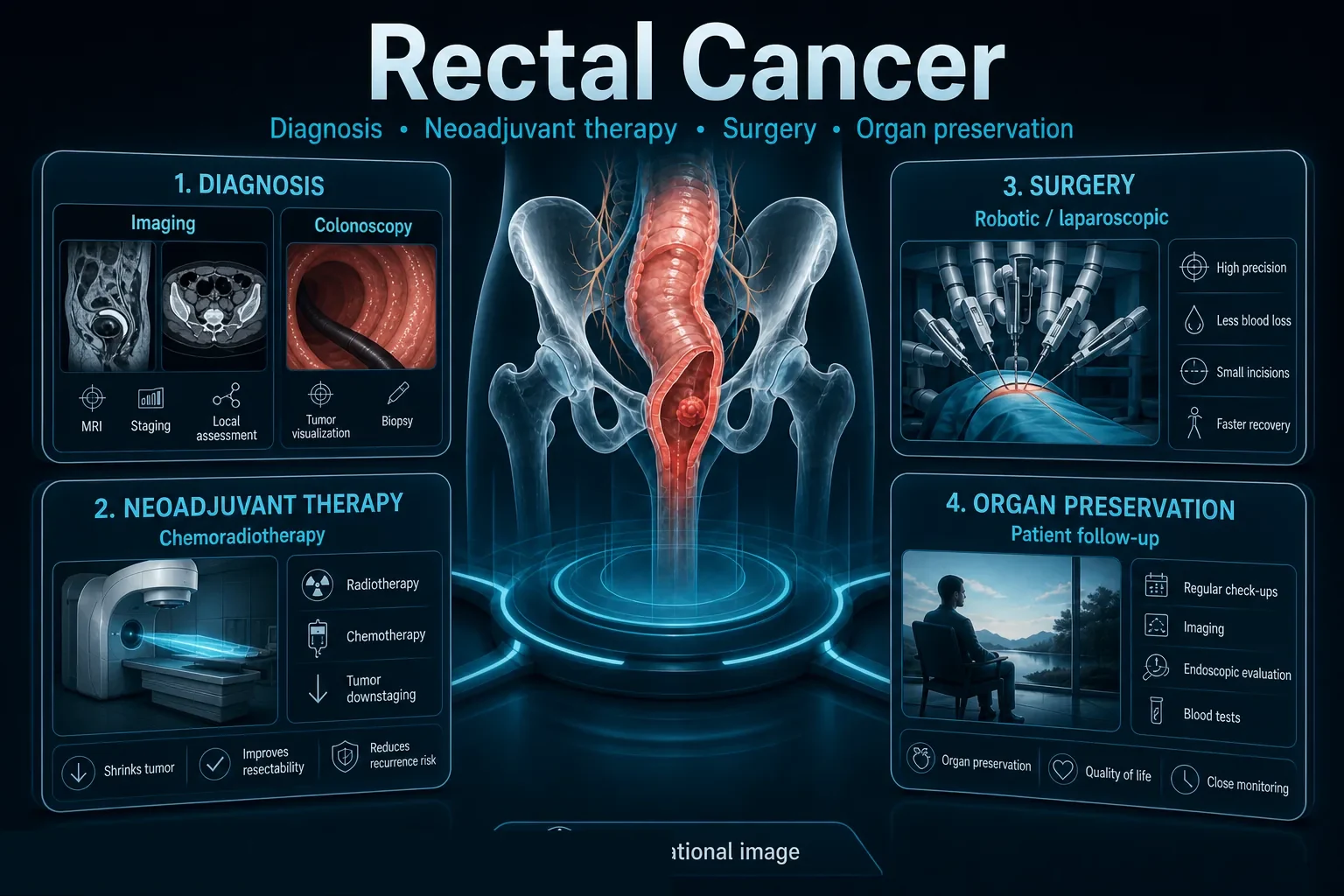
3D educational illustration: rectal anatomy

How did treatment change?

In rectal cancer, the classic “chemoradiotherapy first, then surgery” sequence has opened organ preservation and treatment sequencing to reconsideration in selected patients.

  1. Previous approach

    In locally advanced disease, long-course chemoradiotherapy followed by total mesorectal excision (TME) was common; organ preservation was seen as a limited option.

  2. New clinical evidence

    Total neoadjuvant therapy (TNT), watch-and-wait / organ-preservation studies, and immunotherapy evidence in selected dMMR/MSI-H disease reopened questions of sequence and the necessity of surgery.

  3. Current approach

    TNT, selective radiotherapy, organ preservation, or standard surgery is individualized by stage, MRI findings, molecular features, and patient goals; not every pathway fits every patient.

This summary is for patient education; individual treatment decisions depend on stage, pathology, imaging, and physician assessment.

Landmark status

Sorting

Topic filters

Showing 20 studies.

Comparison table

Select 2 or 3 studies to compare. Different endpoints are never combined in one chart.

Open this discovery in the “Discoveries That Changed Cancer Treatment” hub

Rectal cancer · total neoadjuvant therapy (TNT)

Gold Star — Paradigm-Changing2020 / long-term updateSource verified

RAPIDO

What did the researchers want to learn?

In locally advanced rectal cancer, does completing chemotherapy before surgery after short-course radiotherapy reduce disease-related treatment failure compared with classic long-course chemoradiotherapy?

Before

In locally advanced rectal cancer, surgery after long-course chemoradiotherapy was common; short radiotherapy + consolidation chemotherapy (TNT) was not yet standard.

Today

In selected patients, a TNT approach that brings short-course radiotherapy and systemic therapy forward was strengthened for distant metastasis control; local control is read separately.

What did this study change?

In selected high-risk rectal cancer, options for intensive systemic treatment before surgery (total neoadjuvant therapy, TNT) were strengthened.

Benefit for patients

It concerns the sequence of preoperative treatment in suitable patients with locally advanced rectal cancer.

What did the research find?

In high-risk locally advanced disease, the RAPIDO approach reduced disease-related treatment failure. This does not mean the same plan for every rectal cancer; organ preservation and other TNT schedules are separate studies.

Who does this apply to?

Designed for high-risk locally advanced rectal cancer. It is not automatically generalized to early-stage or low-risk disease, or to patients whose only goal is organ preservation. The overall survival advantage is not the same in every analysis.

What did it not prove?

It did not prove organ preservation or nonoperative surveillance. It does not mean mandatory TNT in all rectal cancers. Local recurrence and distant metastasis endpoints are not interchangeable. It does not show that PRODIGE 23 induction TNT results can be transferred one-to-one to RAPIDO.

This summary is not a treatment recommendation. Decisions depend on the type of disease, stage, general health, and your physician's assessment.

Why this study has a gold star: It is one of the foundational trials driving the development of TNT in high-risk rectal cancer; however, long-term local control findings must alwmos be presented together. (2020–2023 / editorial 2026-10)

Locally advanced rectal cancer · intensive chemotherapy before surgery

Foundational Evidence2020 / 7 -year updateSource verified

UNICANCER-PRODIGE 23

What did the researchers want to learn?

In locally advanced rectal cancer, does adding intensive chemotherapy (mFOLFIRINOX) induction treatment to preoperative radiotherapy and chemotherapy improve long-term outcomes?

Before

In locally advanced rectum, the neoadjuvant sequence was mostly chemoradiotherapy-focused; induction chemotherapy TNT was limited.

Today

In selected patients, TNT that includes induction chemotherapy gained support for disease-free survival.

What did this study change?

In suitable patients who can tolerate intensive chemotherapy, it supports the long-term benefit of an approach in which all treatments are given before surgery.

Benefit for patients

It concerns patients with locally advanced, resectable rectal cancer.

What did the research find?

At seven years of follow-up, the proportions of patients alive without recurrence and alive overall were reported to be higher in the intensive chemotherapy arm than in the control arm. These two measures cannot be used in place of each other; both were reported separately.

Who does this apply to?

The side effects of intensive chemotherapy and patient selection must be evaluated carefully; it is not suitable for every rectal cancer patient.

What did it not prove?

It does not show that every protocol is the same or that organ preservation is guaranteed. It does not show that RAPIDO results can be transferred directly to PRODIGE 23 (or vice versa).

This summary is not a treatment recommendation. Decisions depend on the type of disease, stage, general health, and your physician's assessment.

Rectal cancer · organ preservation

Foundational Evidence2022 / long-termSource verified

OPRA

What did the researchers want to learn?

In selected rectal cancer patients with a complete response, is close surveillance possible instead of surgery?

Before

Immediate surgery after clinical complete response was often preferred; structured surveillance (watch-and-wait) options were limited to selected centers.

Today

In selected patients with clinical complete response, organ preservation with close surveillance became discussable; the total neoadjuvant therapy context matters.

What did this study change?

In selected patients, watch-and-wait became something discussed within multidisciplinary protocols.

Benefit for patients

It concerns selected rectal cancer patients with clinical complete response after preoperative treatment.

What did the research find?

In suitable patients with a complete response, an organ-preservation strategy became stronger as a feasible option in selected centers. A path without surgery is not available for every patient.

Who does this apply to?

Close-surveillance infrastructure, an experienced center and patient adherence are essential. In partial response or suspicious disease, the surgical plan is maintained.

What did it not prove?

It did not prove that pathologic complete response and clinical complete response are the same. It does not show that nonoperative surveillance is safe in every patient.

This summary is not a treatment recommendation. Decisions depend on the type of disease, stage, general health, and your physician's assessment.

Selected rectal cancer · limited use of radiotherapy

Foundational Evidence2023Source verified

PROSPECT

What did the researchers want to learn?

In selected rectal cancer patients who are not at high risk, does giving FOLFOX chemotherapy before surgery and using radiotherapy only when needed fall short of routine chemoradiotherapy in terms of the time before the disease comes back?

Before

In locally advanced rectum, pelvic radiotherapy was accepted as routine in most protocols.

Today

In selected intermediate-risk patients with good response, discussion of a chemotherapy-based approach and selective radiotherapy was strengthened.

What did this study change?

It showed that in a suitably selected group of patients, routine use of radiotherapy can be reduced.

Benefit for patients

It concerns patients with locally advanced rectal cancer in a defined risk group.

What did the research find?

At five years, in terms of time before the disease came back, the approach using radiotherapy sparingly was not worse than routine chemoradiotherapy (the non-inferiority criterion was met).

Who does this apply to?

The results cannot be generalized to all high-risk locally advanced rectal cancers; the eligibility criteria in the protocol are important.

What did it not prove?

It did not prove that radiotherapy is unnecessary in all rectal cancers. It is not automatically generalizable to high-risk disease.

This summary is not a treatment recommendation. Decisions depend on the type of disease, stage, general health, and your physician's assessment.

Locally advanced rectal cancer · sequencing of total preoperative treatment

Emerging Evidence2019+Source verified

CAO/ARO/AIO-12

What did the researchers want to learn?

In total preoperative treatment, how does giving chemotherapy before versus after chemoradiotherapy affect tumor response and long-term outcomes?

Before

The sequence of neoadjuvant regimens and TNT components was debated.

Today

Comparison of different TNT sequences contributed to clarifying protocol choice in treatment planning.

What did this study change?

If organ preservation is the priority, it strengthened the rationale for preferring the sequence of chemoradiotherapy followed by consolidation chemotherapy; the time before the disease came back was equivalent.

Benefit for patients

It concerns patients undergoing neoadjuvant planning for locally advanced rectal cancer.

What did the research find?

The rate of complete disappearance of the tumor at surgery was about 25% (chemoradiotherapy first, then chemotherapy) and 17% (chemotherapy first, then chemoradiotherapy). The time before the disease came back at three years was about 73% in both arms; that is, the difference in response did not translate into a difference in survival / disease-free time.

Who does this apply to?

It is a phase II pick-the-winner design. Complete disappearance of the tumor is not the same thing as the time before the disease comes back.

What did it not prove?

It did not prove universal superiority of a single TNT protocol.

This summary is not a treatment recommendation. Decisions depend on the type of disease, stage, general health, and your physician's assessment.

Locally advanced rectal cancer · short-course radiotherapy

Emerging Evidence2022Source verified

STELLAR

What did the researchers want to learn?

Can an approach containing short-course radiotherapy and chemotherapy be a suitable alternative to long-course chemoradiotherapy?

Before

Systemic therapy strategies after short radiotherapy were being investigated.

Today

In selected patients, short-course and systemic therapy combinations entered the clinical options; comparison arms are read carefully.

What did this study change?

It supported considering short-course radiotherapy plus chemotherapy as an alternative to long-course chemoradiotherapy in selected patients.

Benefit for patients

It concerns patients with locally advanced rectal cancer.

What did the research find?

At three years, the time before the disease came back was about 64.5% (short-course radiotherapy plus chemotherapy) and 62.3% (long-course chemoradiotherapy); the short approach was not worse. Three-year survival rates were about 86.5% and 75.1%. Serious side effects before surgery were more frequent in the short-course plus chemotherapy arm.

Who does this apply to?

The study population and the postoperative drug plan differ between the arms; long-term follow-up is ongoing.

What did it not prove?

It did not prove organ preservation or the same result across all risk groups.

This summary is not a treatment recommendation. Decisions depend on the type of disease, stage, general health, and your physician's assessment.

Locally advanced rectal cancer · short-course radiotherapy + chemotherapy

Emerging Evidence2016+Source verified

POLISH II

What did the researchers want to learn?

In locally advanced, high-risk rectal cancer, can chemotherapy following short-course radiotherapy be an alternative to long-course chemoradiotherapy?

Before

Comparisons of short-course radiotherapy with long chemoradiotherapy were ongoing.

Today

In certain protocols, the place of short-course approaches was discussed with randomized data.

What did this study change?

It laid the groundwork for today's total preoperative treatment studies; it is not identical to current protocols.

Benefit for patients

It concerns rectal cancer patients planned for preoperative radiotherapy.

What did the research find?

The clear (R0) surgical margin rate was about 77% and 71%; the difference was not significant. Early on, three-year survival appeared higher in the short-course radiotherapy arm, but by eight years it had equalized at about 49% in both arms.

Who does this apply to?

Conducted for fixed / advanced tumors. The early survival difference disappeared in the long term; the R0 difference was also not significant.

What did it not prove?

It does not resolve TNT or immunotherapy questions.

This summary is not a treatment recommendation. Decisions depend on the type of disease, stage, general health, and your physician's assessment.

Low rectal cancer · organ preservation after chemoradiotherapy

Emerging Evidence2020 (5 -year)Source verified

GRECCAR 2

What did the researchers want to learn?

In selected small low rectal tumors that respond well to chemoradiotherapy, can removing only the area where the tumor is located (local excision) be an alternative to the standard operation in which the whole rectum is removed?

Before

Completion strategies after local excision were uncertain.

Today

In selected early/responding patients, the limits of organ-preserving approaches began to become clearer.

What did this study change?

It showed that local excision may have a place in the organ-preservation approach; it does not mean that it replaces the standard operation in all T2–T3 rectal cancers.

Benefit for patients

It concerns the local treatment decision in selected rectal cancer patients.

What did the research find?

In the selected patient group, the rate of the tumor coming back in the same area was reported as about 7% in both groups.

Who does this apply to?

Applies to very carefully selected patients; in the local excision group, some patients additionally needed the standard operation.

What did it not prove?

It did not prove replacement of standard TME in advanced T3/T4 disease.

This summary is not a treatment recommendation. Decisions depend on the type of disease, stage, general health, and your physician's assessment.

Rectal cancer · treatment personalized by MRI response

Emerging Evidence2010+Source verified

GRECCAR 4

What did the researchers want to learn?

Is it possible to personalize treatment by looking at the MRI response to chemotherapy before surgery?

Before

The effect of neoadjuvant intensity on surgical outcomes was debated.

Today

In selected patients, neoadjuvant strategy choice was supported by randomized evidence.

What did this study change?

It strengthened the clinical framework for the idea of intensifying or adapting treatment according to MRI response; it cannot be said to have become a standard practice.

Benefit for patients

It concerns patients with locally advanced rectal cancer.

What did the research find?

After four cycles of intensive chemotherapy, about 15 of every hundred patients were considered 'good responders'. The clear surgical margin (R0) rate was 100% in the good-response arms; in poor responders it was about 83% in the standard chemoradiotherapy arm and 88% in the intensified arm. The number of patients in the good-response arms is very small.

Who does this apply to?

Accrual in the good-response arms is low; the results are not generalized to all locally advanced rectal cancer.

What did it not prove?

It does not show that the same intensive protocol is mandatory in every patient.

This summary is not a treatment recommendation. Decisions depend on the type of disease, stage, general health, and your physician's assessment.

Early and intermediate-stage rectal cancer · response-based organ preservation

Emerging Evidence2026 interim resultsSource verified

STAR-TREC

What did the researchers want to learn?

In selected early and intermediate-stage rectal cancer, can an approach that preserves the rectum according to the response to treatment reduce the need for the operation in which the whole rectum is removed?

Before

Organ-preservation strategies in early rectal cancer were at the research stage.

Today

In selected early disease, organ-preserving approaches came onto the agenda through clinical trials.

What did this study change?

It is a current and important study in terms of response-based organ preservation; it has not yet changed standard practice.

Benefit for patients

It concerns selected early-stage rectal cancer patients.

What did the research find?

In patients who preferred organ preservation, the rate of avoiding removal of the rectum at 12 months was reported as 78.5% in the long-course chemoradiotherapy arm and 60.6% in the short-course radiotherapy arm. These are early interim results.

Who does this apply to?

Definite equivalence or superiority should not be stated until longer-term results and cancer-safety assessments are completed. It applies only to selected patients.

What did it not prove?

It cannot be generalized as proof that it is not standard in advanced local disease.

This summary is not a treatment recommendation. Decisions depend on the type of disease, stage, general health, and your physician's assessment.

Open this discovery in the “Discoveries That Changed Cancer Treatment” hub

Rectal cancer · mismatch repair deficiency (dMMR) · complete response without surgery · pilot study

Gold Star — Paradigm-Changing2022Source verified

Dostarlimab — first dMMR rectal study

What did the researchers want to learn?

In locally advanced rectal cancer with mismatch repair deficiency (dMMR), can dostarlimab (a PD-1 inhibitor immunotherapy) given before surgery make the tumor disappear completely on examination and imaging?

Before

In dMMR locally advanced rectum, the standard pathwmo was mostly chemoradiotherapy and surgery.

Today

In selected dMMR patients, high clinical complete response rates with dostarlimab changed the organ-preservation discussion.

What did this study change?

It created a pioneering paradigm signal for a biomarker (dMMR)-based, non-operative organ-preservation approach. AZUR-1 is cross-linked as confirmatory / supporting evidence; it is not a second star.

Benefit for patients

It concerns patients with dMMR/MSI-H locally advanced rectal cancer.

What did the research find?

In all of the first 12 patients who completed treatment, complete disappearance of the tumor on examination and imaging (clinical complete response) was reported.

Who does this apply to?

In the first report the number of patients is very small and follow-up is limited; the results cannot be generalized to all rectal cancer patients. Valid only for patients with mismatch repair deficiency (dMMR).

What did it not prove?

It does not transfer to pMMR disease. Small cohort/long-term OS maturity is interpreted with limits; it does not mean the same protocol in every center.

This summary is not a treatment recommendation. Decisions depend on the type of disease, stage, general health, and your physician's assessment.

Why this study has a gold star: It is a turning point in biomarker-based organ preservation. Physician approval 2026-10-29: gold star (PARADIGM_CHANGING). AZUR-1 is cross-linked as a confirmatory clinical milestone — not a second star. (2022 NEJM · gold-star approval 2026-10-29)

Rectal cancer · mismatch repair deficiency (dMMR) · expanded cohort

Emerging Evidence2022+Source verified

Dostarlimab — expanded cohort

What did the researchers want to learn?

In rectal cancer with mismatch repair deficiency (dMMR), do the strong responses first observed continue in a larger patient group?

Before

After the first dostarlimab signal, broader cohort confirmation was awaited.

Today

Expanded experience supported that immunotherapy response continues in selected dMMR rectum; follow-up remained critical.

What did this study change?

It strengthened the potential for non-operative organ preservation; it is an expanded extension of the MSK pioneering registry — it is not an independent gold star.

Benefit for patients

It concerns patients with dMMR locally advanced rectal cancer.

What did the research find?

A clinical complete response was reported in all 41 patients who completed treatment (ASCO 2024 update). A complete response lasting at least 12 months has been reported in 20 patients. The first NEJM 2022 report was 12/12. These rates are not the same as the independently assessed rate in AZUR-1.

Who does this apply to?

Single-arm study; only for disease with mismatch repair deficiency (dMMR). It is a congress update; long-term and multicenter confirmation is read together with AZUR-1.

What did it not prove?

It does not prove randomized phase III superiority or a pMMR indication.

This summary is not a treatment recommendation. Decisions depend on the type of disease, stage, general health, and your physician's assessment.

Stage II–III rectal cancer · dMMR / microsatellite instability-high (MSI-H) · dostarlimab

Clinical Milestone2026Source verified

AZUR-1 and 2026 FDA approval

What did the researchers want to learn?

In stage II–III locally advanced rectal cancer with mismatch repair deficiency (dMMR) or microsatellite instability-high (MSI-H) status, can a lasting clinical complete response be achieved with dostarlimab?

Before

Perioperative immunotherapy strategies in dMMR rectum were at a developmental stage.

Today

The study offered a framework for evaluating immunotherapy-based approaches on the selected dMMR pathwmo; outcome maturity is monitored.

What did this study change?

International confirmatory AZUR-1 data and FDA accelerated approval (United States) support the MSK pioneering cohort. It is not an independent gold star — it is a clinical milestone.

Benefit for patients

It concerns patients with dMMR rectal cancer.

What did the research find?

The US drug authority (FDA) granted accelerated approval to dostarlimab for this use on 19 October 2026. On independent central review, the 12-month clinical complete response was about 47% (116 patients); on investigator assessment, about 68% was reported. These two rates are not the same thing. In addition, there are patients with a complete response who have been followed for less than 12 months; close follow-up is needed.

Who does this apply to?

Single-arm design. Accelerated approval is not lasting cure. FDA confirmation: study completion target October 2029; final report July 2030. Licensing in Turkey is separate. Valid only for disease with dMMR or MSI-H (microsatellite instability-high) status.

What did it not prove?

This card alone does not prove a final standard change or generalization to pMMR.

This summary is not a treatment recommendation. Decisions depend on the type of disease, stage, general health, and your physician's assessment.

Locally advanced rectal cancer · chemoradiotherapy before or after surgery

Foundational Evidence2004Source verified

German Rectal Cancer Study / CAO/ARO/AIO-94

What did the researchers want to learn?

In locally advanced rectal cancer, does giving chemoradiotherapy before surgery or after surgery lead to better outcomes?

Before

The place of preoperative chemoradiotherapy was still being clarified.

Today

Preoperative chemoradiotherapy became one of the standard foundations in selected locally advanced rectum.

What did this study change?

It formed the basis for preoperative chemoradiotherapy becoming standard.

Benefit for patients

It concerns patients with locally advanced rectal cancer.

What did the research find?

Five-year local recurrence was about 6% (before surgery) and 13% (after surgery); survival was similar (Sauer NEJM 2004). That is, the benefit in local control stood out; this does not mean survival was prolonged.

Who does this apply to?

Today's MRI staging, surgical quality and drug treatments differ from those in the study era; the results cannot be applied one-to-one to a patient today.

What did it not prove?

It alone does not prove that it replaces short-course or TNT protocols.

This summary is not a treatment recommendation. Decisions depend on the type of disease, stage, general health, and your physician's assessment.

Operable rectal cancer · short-course radiotherapy before surgery

Foundational Evidence2009Source verified

MRC CR07 / NCIC-CTG C016

What did the researchers want to learn?

Does short-course radiotherapy before surgery reduce the tumor coming back in the same area compared with a selective postoperative chemoradiotherapy approach?

Before

Preoperative and postoperative radiotherapy strategies were debated.

Today

The role of preoperative radiotherapy for local control in selected patients was strengthened.

What did this study change?

It strengthened the place of short-course preoperative radiotherapy in local control.

Benefit for patients

It concerns patients for whom radiotherapy timing in rectal cancer is being discussed.

What did the research find?

Three-year local recurrence was about 4.4% (short-course radiotherapy before surgery) and 10.6% (selective postoperative chemoradiotherapy) (Lancet 2009). Local recurrence is not the same thing as survival.

Who does this apply to?

Conducted in a context before modern staging and total neoadjuvant treatment.

What did it not prove?

It does not cover modern TNT and immunotherapy questions.

This summary is not a treatment recommendation. Decisions depend on the type of disease, stage, general health, and your physician's assessment.

Operable rectal cancer · surgical quality and short-course radiotherapy

Foundational Evidence2001Source verified

Dutch TME Trial

What did the researchers want to learn?

Does adding short-course radiotherapy before surgery to standardized rectal excision surgery (TME, total mesorectal excision) reduce the tumor coming back in the same area?

Before

The joint role of TME surgery and preoperative short radiotherapy was being investigated.

Today

Short preoperative radiotherapy + TME provided important evidence for reducing local recurrence.

What did this study change?

It became one of the cornerstones of the discussion of high-quality standard surgery together with short-course radiotherapy.

Benefit for patients

It concerns patients with resectable rectal cancer.

What did the research find?

Two-year local recurrence was about 2.4% (short-course radiotherapy plus standard surgery) and 8.2% (standard surgery alone) (NEJM 2001). It showed that surgical quality and radiotherapy need to be evaluated together.

Who does this apply to?

Long-term side effects and bowel function outcomes must also be evaluated. Modern staging and treatments differ from those in the study era.

What did it not prove?

It is not considered to have proven the same effect on distant metastasis or overall survival in every analysis.

This summary is not a treatment recommendation. Decisions depend on the type of disease, stage, general health, and your physician's assessment.

Rectal cancer · laparoscopic (keyhole) surgery

Foundational Evidence2015Source verified

COLOR II

What did the researchers want to learn?

In rectal cancer, is laparoscopic (keyhole) surgery comparable with open surgery in terms of cancer outcomes?

Before

The oncologic safety of laparoscopic TME in rectal cancer was debated.

Today

In suitable centers, the laparoscopic approach was supported as an alternative to open surgery in selected patients.

What did this study change?

It supported the view that the laparoscopic approach can be an option in terms of cancer outcomes in experienced centers.

Benefit for patients

It concerns rectal cancer patients for whom surgical approach is being chosen.

What did the research find?

Three-year locoregional recurrence was about 5% in both arms (NEJM 2015). It is one of the pieces of evidence for the oncologic safety of the keyhole method in experienced centers; it is not a claim of survival superiority.

Who does this apply to?

The surgeon's experience, patient selection and long-term results are important.

What did it not prove?

It did not prove that laparoscopy is mandatory or superior in every tumor.

This summary is not a treatment recommendation. Decisions depend on the type of disease, stage, general health, and your physician's assessment.

Rectal cancer · laparoscopic surgery · pathology quality

Emerging Evidence2015Source verified

ALaCaRT

What did the researchers want to learn?

Is laparoscopic (keyhole) rectal cancer surgery equivalent to open surgery in terms of the quality of the tissue removed?

Before

The pathologic adequacy of laparoscopic rectal surgery was questioned.

Today

The trial showed that the laparoscopic approach was not non-inferior to open surgery on some pathologic criteria, making selection more cautious.

What did this study change?

It showed that the quality of tissue removed by keyhole surgery needs to be evaluated carefully and that this measure needs to be interpreted separately.

Benefit for patients

It concerns the rectal cancer surgical approach decision.

What did the research find?

On early pathology measures, it could not be shown that laparoscopy was not worse than open surgery; that is, the main goal of the study was not met. This does not mean that the keyhole method is worse in every patient.

Who does this apply to?

Conducted for selected surgeons and selected patients; the failure to demonstrate equivalence does not mean laparoscopy is worse in every patient.

What did it not prove?

It does not show that laparoscopy is banned everywhere or that it covers robotic surgery.

This summary is not a treatment recommendation. Decisions depend on the type of disease, stage, general health, and your physician's assessment.

Rectal cancer · laparoscopic surgery · pathology quality

Emerging Evidence2015Source verified

ACOSOG Z6051

What did the researchers want to learn?

Is laparoscopic rectal cancer surgery equivalent to open surgery in terms of the quality of the tissue removed?

Before

The oncologic adequacy of laparoscopic rectal surgery was also debated in the US.

Today

Laparoscopy was not non-inferior on certain pathologic success criteria; patient selection and surgeon experience were emphasized.

What did this study change?

It allowed the quality of tissue from keyhole surgery to be read as separate evidence and emphasized careful patient and surgeon selection.

Benefit for patients

It concerns candidates for minimally invasive rectal cancer surgery.

What did the research find?

Similar to the ALaCaRT study, on early pathology measures it could not be shown that laparoscopy was not worse than open surgery; that is, the main goal of the study was not met.

Who does this apply to?

The failure to demonstrate equivalence does not mean laparoscopy is worse in every patient. The two studies addressing the same question are presented on the page as separate cards.

What did it not prove?

It alone does not prove that open surgery is mandatory in every patient or a long-term OS difference.

This summary is not a treatment recommendation. Decisions depend on the type of disease, stage, general health, and your physician's assessment.

Rectal cancer · robot-assisted surgery

Emerging Evidence2017Source verified

ROLARR

What did the researchers want to learn?

Does robot-assisted rectal surgery reduce the need to convert to open surgery during the operation compared with laparoscopic surgery?

Before

While robotic rectal surgery was spreading, superiority over open/laparoscopic was uncertain.

Today

Possible benefits of the robotic approach for conversion and some surgical criteria are discussed; claims of oncologic superiority are cautious.

What did this study change?

It was a reminder that conversion to open surgery, cancer outcomes and bowel / urinary function outcomes need to be read together; it did not prove the superiority of robotic surgery.

Benefit for patients

It concerns patients considering robotic surgery for rectal cancer.

What did the research find?

Conversion to open surgery was about 8.1% (robotic) and 12.2% (laparoscopic); the difference was not statistically significant (JAMA 2017). Conversion rate is not survival or local recurrence superiority.

Who does this apply to?

The surgeon's experience, the learning curve, cost and the change of technology over time are important.

What did it not prove?

It did not prove oncologic survival superiority or mandatory robotic surgery in every center.

This summary is not a treatment recommendation. Decisions depend on the type of disease, stage, general health, and your physician's assessment.

Comparative clinical summary of the trials

Which trials support TNT?

RAPIDO, UNICANCER-PRODIGE 23, OPRA, CAO/ARO/AIO-12, STELLAR, and POLISH II evaluate TNT or near-TNT neoadjuvant strategies. Support does not rest on the same primary endpoint in every trial.

Which trials focus on organ preservation?

OPRA (TME-free survival secondary), GRECCAR 2 (local excision), STAR-TREC (response-based organ preservation), and dostarlimab cohorts (dMMR/MSI-H) sit in an organ-preservation context.

Which trial investigates reducing radiotherapy in selected patients?

PROSPECT: selective chemoradiotherapy after neoadjuvant FOLFOX in selected lower-risk patients; primary endpoint DFS non-inferiority.

Which trials evaluate dMMR/MSI-H immunotherapy?

Dostarlimab first dMMR study, expanded cohort, and AZUR-1 / 2026 FDA accelerated approval context.

Which trials examine the oncologic safety of surgical technique?

COLOR II (laparoscopic vs open), ALaCaRT and ACOSOG Z6051 (pathologic quality non-inferiority), ROLARR (robotic vs laparoscopic conversion).

Which outcomes are primary, and which are secondary or exploratory?

Each card lists the primary endpoint separately. E.g., in OPRA the primary is DFS and TME-free survival is an important secondary; in RAPIDO the primary is disease-related treatment failure — not the same as DFS.

Which trials’ long-term results carry a different caveat from the first report?

RAPIDO: long-term adverse signal for locoregional recurrence in the experimental arm. STAR-TREC: 2026 interim results are early; equivalence should not be claimed before long-term oncologic safety is complete. Dostarlimab/AZUR-1: accelerated approval is not proof of durable cure.

Medical editor's note

Each study was designed for a specific patient group, treatment arm, and primary endpoint. Results should not be automatically generalized to other diseases or to all patients. This atlas is educational and is not a treatment recommendation.

Evidence

Scientific sources

Show sources · 15

Rectal cancer landmark atlas: verified summaries of TNT, organ preservation, selective RT, dMMR/MSI-H immunotherapy, and surgical-technique trials. DFS/OS/pCR/cCR/TME-free/DRTF are not interchangeable. Numeric cards live only on this page.

  1. Management of Locally Advanced Rectal Cancer: ASCO GuidelineAmerican Society of Clinical Oncology (ASCO) · 2024 · DOI: 10.1200/JCO.24.01160Open source
  2. RAPIDO — short-course radiotherapy followed by chemotherapy before TME versus preoperative chemoradiotherapy (phase III)The Lancet Oncology · 2021Open source
  3. UNICANCER-PRODIGE 23 — long-term outcomes of induction mFOLFIRINOX in locally advanced rectal cancerPubMed · 2024+Open source
  4. Organ Preservation in Patients With Rectal Adenocarcinoma Treated With Total Neoadjuvant Therapy (OPRA)Journal of Clinical Oncology · 2022 · DOI: 10.1200/JCO.22.00032Open source
  5. Long-term Results of Organ Preservation in Patients With Rectal Adenocarcinoma Treated With Total Neoadjuvant Therapy (OPRA)Journal of Clinical Oncology / PubMed · 2023+Open source
  6. PROSPECT — preoperative FOLFOX versus chemoradiotherapy for selected rectal cancer (phase III)New England Journal of Medicine · 2023Open source
  7. STELLAR — short-term radiotherapy plus chemotherapy versus long-term chemoradiotherapy (phase III)Journal of Clinical Oncology / PubMed · 2022Open source
  8. GRECCAR 2 — local excision versus TME after chemoradiotherapy in selected low rectal cancersPubMed · 2020Open source
  9. STAR-TREC — organ preservation strategies in early/intermediate rectal cancer (interim)PubMed · 2026Open source
  10. PD-1 Blockade in Mismatch Repair–Deficient Locally Advanced Rectal Cancer (dostarlimab)New England Journal of Medicine · 2022Open source
  11. FDA grants accelerated approval to dostarlimab for locally advanced rectal cancer (AZUR-1 context)U.S. Food and Drug Administration · 2026Open source
  12. German Rectal Cancer Study (CAO/ARO/AIO-94) — preoperative versus postoperative chemoradiotherapyNew England Journal of Medicine · 2004Open source
  13. Dutch TME Trial — preoperative radiotherapy combined with total mesorectal excisionNew England Journal of Medicine · 2001Open source
  14. Rectal cancer: ESMO Clinical Practice Guidelines for diagnosis, treatment and follow-upESMO · 2017 (see the ESMO GI portal for updates) · DOI: 10.1093/annonc/mdx224Open source
  15. NCCN Clinical Practice Guidelines in Oncology: Rectal CancerNCCN · Current versionOpen source

Source list last checked: 31 October 2026. (Page content review date may appear separately above.)