Disease-specific landmark atlas · Gastric

Gastric Cancer Landmark Atlas

Landmark studies on perioperative FLOT and durvalumab, East Asian adjuvant approaches, HER2, CLDN18.2, and first-line immunotherapy.

DFS, OS, pCR, cCR, and similar endpoints are not interchangeable. Gold stars are never assigned automatically. Numeric cards are verified summaries of primary publications. A patient summary is not a treatment recommendation.

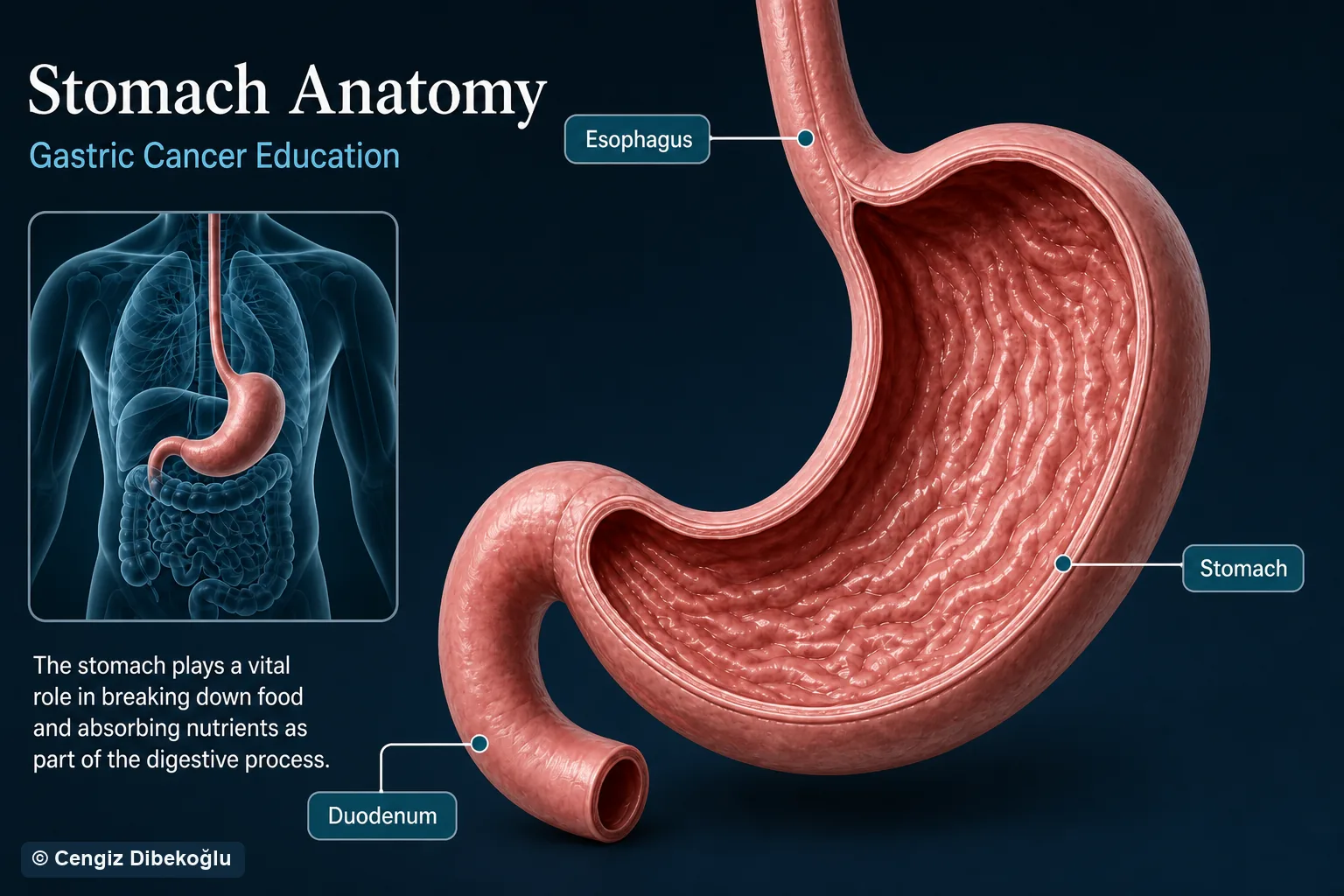
3D educational illustration: stomach anatomy

How did treatment change?

In gastric and gastroesophageal-junction cancer, perioperative chemotherapy and immunotherapy have accelerated the move beyond a “surgery-only” era.

  1. Previous approach

    In locally advanced disease, plans were surgery-centered; systemic therapy was often left for after surgery or for advanced stages.

  2. New clinical evidence

    MAGIC / FLOT4 perioperative chemotherapy and studies such as CheckMate-649 / MATTERHORN redefined sequencing and immunotherapy addition.

  3. Current approach

    Perioperative or advanced-stage systemic therapy is individualized by stage, HER2 / PD-L1 / MSI status, and surgical fitness.

This summary is for patient education; individual treatment decisions depend on stage, pathology, imaging, and physician assessment.

Landmark status

Sorting

Topic filters

Showing 18 studies.

Comparison table

Select 2 or 3 studies to compare. Different endpoints are never combined in one chart.

Gastric and esophagogastric junction cancer · chemotherapy before and after surgery

Foundational Evidence2006Source verified

MAGIC

What did the researchers want to learn?

In operable gastric, esophagogastric junction or lower esophageal cancers, is giving chemotherapy before and after surgery better than surgery alone?

Before

Perioperative chemotherapy was not routine in operable gastric cancer.

Today

Perioperative chemotherapy became one of the standard approaches in selected patients.

What did this study change?

It became one of the key studies showing the importance of chemotherapy spread across the period before and after surgery.

Benefit for patients

Relevant to patients with operable gastric cancer.

What did the research find?

The five-year survival rate was about 36% in the chemotherapy group and 23% in the surgery-alone group (hazard ratio for death 0.75; p=0.009).

Who does this apply to?

The ECF chemotherapy used is an older regimen that FLOT has replaced in many patients today. The study covers not only gastric cancer but also tumors of the junction region and the lower esophagus.

What did it not prove?

It is not the same regimen as modern FLOT. It does not prove the same benefit at every stage.

This summary is not a treatment recommendation. Decisions depend on the type of disease, stage, general health, and your physician's assessment.

Open this discovery in the “Discoveries That Changed Cancer Treatment” hub

Gastric / gastroesophageal junction (GEJ) cancer · perioperative chemotherapy

Gold Star — Paradigm-Changing2019Source verified

FLOT4

What did the researchers want to learn?

In resectable gastric or esophagogastric junction cancer, is FLOT chemotherapy before and after surgery better than the older ECF/ECX regimen?

Before

Perioperative ECF/ECX was common; the superiority of FLOT was not clear.

Today

In eligible patients, perioperative FLOT became one of the preferred regimens.

What did this study change?

In suitable resectable gastric / GEJ cancer, perioperative FLOT became the reference chemotherapy in many centers.

Benefit for patients

Relevant to patients with operable gastric/GEJ adenocarcinoma.

What did the research find?

Median overall survival was reported as 50 months in the FLOT group and 35 months in the ECF/ECX group (hazard ratio [HR] 0.77). This does not mean every patient will live 50 months; FLOT4 did not compare FLOT with CROSS.

Who does this apply to?

For patients who are operable and in good performance status. It is not the same as metastatic disease or East Asian adjuvant approaches. Side-effect management and nutritional support are critical. The comparison with CROSS is in ESOPEC.

What did it not prove?

By itself it does not settle metastatic disease or immunotherapy combinations.

This summary is not a treatment recommendation. Decisions depend on the type of disease, stage, general health, and your physician's assessment.

Why this study has a gold star: Made FLOT an important standard in eligible resectable gastric and gastroesophageal junction adenocarcinomas. (2019 / editorial 2026-10)

Open this discovery in the “Discoveries That Changed Cancer Treatment” hub

Resectable gastric / GEJ adenocarcinoma · perioperative immunotherapy

Gold Star — Paradigm-Changing2025 EFS / 2026 final OSSource verified

MATTERHORN

What did the researchers want to learn?

In operable gastric / gastroesophageal junction (GEJ) cancer, does adding durvalumab to FLOT improve outcomes?

Before

In the West, perioperative FLOT (or similar) was the foundation; there was no routine perioperative IO.

Today

In eligible patients, adding durvalumab to FLOT is discussed.

What did this study change?

In suitable resectable patients, perioperative FLOT plus durvalumab was strengthened as an option.

Benefit for patients

Potential for longer event-free time and overall survival.

What did the research find?

Lancet 2026 final overall survival (OS): hazard ratio (HR) for death 0.78 (95% confidence interval [CI] 0.63–0.96). An event-free survival (EFS) benefit had also been reported earlier (2-year EFS 67.4% vs 58.5%). It does not mean automatic immunotherapy for all gastric cancer patients; licensing is separate by country (US FDA November 2025).

Who does this apply to?

Resectable gastric / GEJ adenocarcinoma. Not to be confused with metastatic CheckMate 649 or with thoracic squamous cell carcinoma. Immune-related toxicity; access in Turkey / EMA (European Medicines Agency) is not automatically equal to FDA approval.

What did it not prove?

It does not smo IO is mandatory for every patient. It is not the same question as metastatic 1L CheckMate-649. Not generalized to squamous cell thoracic esophageal cancer.

This summary is not a treatment recommendation. Decisions depend on the type of disease, stage, general health, and your physician's assessment.

Why this study has a gold star: A phase III trial showing EFS and final OS benefit of adding durvalumab to perioperative FLOT; it established the perioperative IO era. In the US, the FDA approved this indication on November 25, 2025 (FDA.gov); EMA/Turkey authorization must be verified separately — a study result alone does not mean authorization in every country. (2025 NEJM EFS / 2026 Lancet OS · editorial approval 2026-10)

Operable gastric / gastroesophageal junction cancer · radiotherapy before surgery

Emerging Evidence2024Source verified

TOPGEAR

What did the researchers want to learn?

Does adding radiotherapy before surgery to perioperative chemotherapy prolong survival?

Before

The added benefit of preoperative chemoradiotherapy on top of perioperative chemotherapy was unclear.

Today

In this study, OS superiority of additional preoperative RT was not shown; protocol choice becomes individualized.

What did this study change?

It did not support routinely adding preoperative radiotherapy to every operable gastric cancer.

Benefit for patients

Relevant to patients with operable gastric/GEJ cancer.

What did the research find?

The study's main goal, a prolongation of survival, could not be shown (median survival 46 months and 49 months; hazard ratio 1.05). Improvement was seen in some measures, such as the rate of complete disappearance of the tumor at surgery, 17% vs 8%.

Who does this apply to?

This result does not show that radiotherapy is unnecessary in all gastric or esophageal cancers; anatomical location and surgical margins are important. The study's long accrual period and the chemotherapy regimens used must also be taken into account.

What did it not prove?

It does not prove that radiotherapy has no role at all or that it invalidates FLOT.

This summary is not a treatment recommendation. Decisions depend on the type of disease, stage, general health, and your physician's assessment.

Operable gastric / gastroesophageal junction cancer · postoperative treatment

Emerging Evidence2018Source verified

CRITICS

What did the researchers want to learn?

After chemotherapy before surgery, is giving chemoradiotherapy after surgery better than giving chemotherapy alone after surgery?

Before

The comparison of adjuvant chemoradiotherapy versus chemotherapy was being debated.

Today

The added benefit of chemoradiotherapy in adjuvant plans did not become clear in this design; its selection is limited.

What did this study change?

It cannot be said that postoperative chemoradiotherapy routinely prolongs survival; it provided information about how treatment is distributed before and after surgery.

Benefit for patients

Relevant to patients with gastric cancer after surgery.

What did the research find?

Superiority of postoperative chemoradiotherapy in terms of survival could not be shown; that is, the main goal of the study was not met (median survival 43 months and 37 months; hazard ratio 1.01).

Who does this apply to?

The rate of completing postoperative treatment was low (about 60%); this affects the interpretation of the result.

What did it not prove?

Does not carry over one-to-one to the neoadjuvant/perioperative FLOT era.

This summary is not a treatment recommendation. Decisions depend on the type of disease, stage, general health, and your physician's assessment.

Stage II–III gastric cancer · chemotherapy after D2 surgery

Foundational Evidence2012 / long-termSource verified

CLASSIC

What did the researchers want to learn?

After gastric surgery performed with extensive lymph node clearance (D2), is CAPOX chemotherapy more beneficial than observation alone?

Before

The benefit of adjuvant chemotherapy after D2 dissection was unclear outside Asia.

Today

Adjuvant chemotherapy gained support in selected patients; surgical quality remained critical.

What did this study change?

It contributed to the development of chemotherapy strategies after high-quality D2 surgery in particular.

Benefit for patients

Relevant to patients who have undergone surgery for gastric cancer.

What did the research find?

With postoperative CAPOX, the time before the disease came back improved; the disease-free rate three years later was 74% vs 59% (hazard ratio 0.56).

Who does this apply to?

The geography in which the study was conducted and the quality of surgery must be taken into account; the results cannot be transferred directly to patients in every country.

What did it not prove?

It is not the same question as perioperative FLOT.

This summary is not a treatment recommendation. Decisions depend on the type of disease, stage, general health, and your physician's assessment.

Stage II–III gastric cancer · Japan · S-1 after D2 surgery

Foundational Evidence2007 / 5y analizSource verified

ACTS-GC

What did the researchers want to learn?

After D2 gastric surgery, does S-1, an oral chemotherapy, prolong survival?

Before

Adjuvant S-1 was being investigated in Asian practice.

Today

In selected East Asian populations, adjuvant S-1 became one of the standards.

What did this study change?

It was decisive in the development of postoperative chemotherapy in East Asia.

Benefit for patients

Relevant to patients who have undergone surgery for gastric cancer (the study population).

What did the research find?

Postoperative S-1 improved survival; the proportion of patients alive three years later was 80.1% vs 70.1%.

Who does this apply to?

The availability of S-1 and the fact that response to the drug differs between populations must be taken into account; the study was conducted in Japan.

What did it not prove?

Does not automatically generalize to Western populations or to FLOT.

This summary is not a treatment recommendation. Decisions depend on the type of disease, stage, general health, and your physician's assessment.

Advanced gastric cancer · a single non-curable factor · adding surgery

Emerging Evidence2016Source verified

REGATTA

What did the researchers want to learn?

In selected advanced gastric cancer with a single cause of spread that surgery alone cannot resolve (liver, peritoneum or lymph nodes around the main vessel), does adding gastric surgery to chemotherapy prolong survival?

Before

The benefit of primary tumor resection in metastatic gastric cancer was unclear.

Today

Superiority of routine gastrectomy + chemotherapy was not shown; selection is very limited.

What did this study change?

It called into question the benefit of routinely removing the primary tumor in spread gastric cancer, except for symptom control or special circumstances.

Benefit for patients

Relevant to patients with gastric cancer with limited metastases.

What did the research find?

Adding gastric surgery did not improve survival (median 14.3 months and 16.6 months; hazard ratio 1.09); that is, the main goal of the study was not met.

Who does this apply to?

It cannot be generalized to all situations of limited spread; the study covers only specific selected patients.

What did it not prove?

Does not prove that surgery is useless in all oligometastatic scenarios.

This summary is not a treatment recommendation. Decisions depend on the type of disease, stage, general health, and your physician's assessment.

HER2-positive advanced gastric / gastroesophageal junction cancer · trastuzumab

Foundational Evidence2010Source verified

ToGA

What did the researchers want to learn?

In advanced gastric or junction cancer that is positive for the protein HER2, is adding trastuzumab to chemotherapy beneficial?

Before

Anti-HER2 therapy was not standard in HER2+ advanced gastric cancer.

Today

Trastuzumab + chemotherapy became the standard option in HER2+ advanced disease.

What did this study change?

It showed the importance of HER2 testing and targeted therapy in advanced gastric cancer.

Benefit for patients

Relevant to patients with HER2-positive advanced gastric/GEJ cancer.

What did the research find?

Median survival was 13.8 months in the group with trastuzumab added and 11.1 months in the chemotherapy-alone group (hazard ratio 0.74).

Who does this apply to?

Valid only for patients confirmed to be HER2-positive.

What did it not prove?

Does not carry over to HER2-negative disease.

This summary is not a treatment recommendation. Decisions depend on the type of disease, stage, general health, and your physician's assessment.

Open this discovery in the “Discoveries That Changed Cancer Treatment” hub

Gastric / GEJ / esophageal adenocarcinoma · advanced first-line

Gold Star — Paradigm-Changing2021Source verified

CheckMate-649

What did the researchers want to learn?

In advanced gastric / gastroesophageal junction (GEJ) / esophageal adenocarcinoma, does adding nivolumab to chemotherapy prolong survival?

Before

There was no routine IO in 1L for advanced upper GI adenocarcinoma; chemotherapy was the foundation.

Today

In eligible patients (especially CPS ≥5), nivolumab + chemotherapy is considered.

What did this study change?

In suitable advanced HER2-negative upper gastrointestinal adenocarcinoma, first-line nivolumab plus chemotherapy (especially with PD-L1 combined positive score [CPS] ≥5) became a standard option.

Benefit for patients

Longer overall survival in selected patients; the benefit varies according to PD-L1 CPS.

What did the research find?

With a PD-L1 combined positive score (CPS) of 5 or higher, median survival was 14.4 vs 11.1 months. With CPS 1 or higher it was 14.0 vs 11.3 months; in all randomized patients it was 13.8 vs 11.6 months. The clearest evidence is in the CPS ≥5 group.

Who does this apply to?

HER2-negative adenocarcinoma. PD-L1 combined positive score (CPS) strata are read separately. It is not confused with perioperative FLOT / MATTERHORN or with esophageal squamous cell carcinoma (CM-648).

What did it not prove?

It did not prove the same benefit in every patient with low CPS. It is separate from the HER2+ ToGA/KEYNOTE-811 pathwmo. It does not answer the perioperative question. It is not squamous cell esophageal cancer (CheckMate-648).

This summary is not a treatment recommendation. Decisions depend on the type of disease, stage, general health, and your physician's assessment.

Why this study has a gold star: Made 1L nivolumab + CT (especially CPS ≥5) one of the standard options in advanced HER2-negative upper GI adenocarcinoma. (2021 Lancet · editorial approval 2026-10)

HER2-negative advanced gastric / gastroesophageal junction cancer · immunotherapy

Foundational Evidence2023Source verified

KEYNOTE-859

What did the researchers want to learn?

In HER2-negative advanced gastric or junction adenocarcinoma, is adding pembrolizumab to chemotherapy beneficial?

Before

PD-1 inhibitor + chemotherapy first-line options were evolving in advanced gastric cancer.

Today

Pembrolizumab + chemotherapy was strengthened as a first-line option in eligible patients.

What did this study change?

It broadened immunotherapy options in advanced-stage gastric cancer.

Benefit for patients

Relevant to patients with advanced/metastatic gastric or GEJ adenocarcinoma.

What did the research find?

Adding pembrolizumab to chemotherapy improved survival (median 12.9 months and 11.5 months; hazard ratio 0.78).

Who does this apply to?

The absolute benefit may differ according to PD-L1 and other biomarkers; individualized assessment is needed.

What did it not prove?

Does not settle the early perioperative FLOT question; biomarkers and approval conditions are important.

This summary is not a treatment recommendation. Decisions depend on the type of disease, stage, general health, and your physician's assessment.

CLDN18.2-positive, HER2-negative advanced gastric / junction cancer · zolbetuximab

Emerging Evidence2023Source verified

SPOTLIGHT

What did the researchers want to learn?

In HER2-negative advanced gastric or junction cancer carrying the protein CLDN18.2, is adding zolbetuximab to chemotherapy beneficial?

Before

CLDN18.2-targeted therapy was not a clinical option.

Today

In eligible CLDN18.2-positive patients, zolbetuximab + chemotherapy became an option.

What did this study change?

It made CLDN18.2 an important test that guides treatment in advanced gastric cancer.

Benefit for patients

Relevant to patients with CLDN18.2-positive advanced gastric/GEJ cancer.

What did the research find?

Benefit was shown in progression-free survival (time before the disease progressed) and overall survival (median progression-free survival 10.61 months and 8.67 months; overall survival 18.23 months and 15.54 months; hazard ratio 0.75 for both).

Who does this apply to?

The test's threshold values and side effects such as nausea and vomiting are important; valid only for CLDN18.2-positive patients.

What did it not prove?

Does not generalize to target-negative disease.

This summary is not a treatment recommendation. Decisions depend on the type of disease, stage, general health, and your physician's assessment.

CLDN18.2-positive, HER2-negative advanced gastric / junction cancer · zolbetuximab + CAPOX

Emerging Evidence2023Source verified

GLOW

What did the researchers want to learn?

In CLDN18.2-positive advanced gastric or junction cancer, is zolbetuximab together with CAPOX chemotherapy effective?

Before

Other CLDN18.2-targeted regimens were being investigated.

Today

CAPOX + zolbetuximab gained support in eligible CLDN18.2+ patients.

What did this study change?

Together with SPOTLIGHT, it strengthened the evidence for CLDN18.2-targeted therapy.

Benefit for patients

Relevant to patients with CLDN18.2-positive advanced gastric cancer.

What did the research find?

Benefit was shown in progression-free survival (time before the disease progressed) and overall survival (median progression-free survival 8.21 months and 6.80 months; overall survival 14.39 months and 12.16 months).

Who does this apply to?

The type of chemotherapy used and differences in side effects must be evaluated. Superiority cannot be inferred by direct comparison with SPOTLIGHT; valid only for CLDN18.2-positive patients.

What did it not prove?

It does not have the same chemotherapy backbone as SPOTLIGHT; target testing is mandatory.

This summary is not a treatment recommendation. Decisions depend on the type of disease, stage, general health, and your physician's assessment.

HER2-positive advanced gastric / junction cancer · trastuzumab deruxtecan (previously treated with trastuzumab)

Emerging Evidence2020Source verified

DESTINY-Gastric01

What did the researchers want to learn?

In HER2-positive advanced gastric cancer previously treated with trastuzumab, is trastuzumab deruxtecan effective?

Before

T-DXd options after HER2+ disease were limited.

Today

Trastuzumab deruxtecan became an important option in previously treated HER2+ disease.

What did this study change?

It demonstrated the importance of HER2-targeted antibody–drug conjugates in advanced gastric cancer.

Benefit for patients

Relevant to previously treated patients with HER2+ advanced gastric/GEJ cancer.

What did the research find?

The tumor shrinkage (response) rate was reported as 51% vs 14% and median survival as 12.5 months and 8.4 months; superiority over chemotherapy was shown.

Who does this apply to?

The risk of drug-related lung inflammation (interstitial lung disease) must be monitored carefully. The study mainly included Asian patients and its primary endpoint is the tumor response rate.

What did it not prove?

Does not replace first-line ToGA.

This summary is not a treatment recommendation. Decisions depend on the type of disease, stage, general health, and your physician's assessment.

HER2-positive advanced gastric / junction cancer · progression after trastuzumab · Western population

Emerging Evidence2023Study / result verification pending

DESTINY-Gastric02

What did the researchers want to learn?

In HER2-positive advanced gastric cancer that has progressed after trastuzumab, how effective is trastuzumab deruxtecan?

Before

T-DXd data in the Western population were limited.

Today

T-DXd activity was supported in a selected Western cohort.

What did this study change?

It provided additional evidence for targeted therapy strategies after prior HER2 therapy.

Benefit for patients

Relevant to previously treated HER2+ gastric/GEJ patients.

What did the research find?

Clinically meaningful tumor responses were shown (confirmed response rate about 42%). There is no comparison (control) group.

Who does this apply to?

Because there is no comparison group, a direct superiority comparison with DESTINY-Gastric01 cannot be made. Valid only for selected HER2-positive patients.

What did it not prove?

It does not prove randomized superiority or an adjuvant indication.

This summary is not a treatment recommendation. Decisions depend on the type of disease, stage, general health, and your physician's assessment.

HER2-positive advanced / metastatic gastric / GEJ · second-line trastuzumab deruxtecan (T-DXd)

Under review for paradigm-changing status2025Source verified

DESTINY-Gastric04

What did the researchers want to learn?

In HER2-positive advanced gastric cancer that has progressed after trastuzumab, does trastuzumab deruxtecan prolong life compared with ramucirumab plus paclitaxel?

Before

Evidence for T-DXd in the second line after trastuzumab was largely based on phase II / single-arm records; ramucirumab + paclitaxel was the common comparator option.

Today

In eligible HER2+ (confirmed after progression) second line, T-DXd was strengthened as a phase III option showing OS superiority over RAM+PTX; ILD monitoring is mandatory.

What did this study change?

Comparative phase III overall survival evidence for T-DXd in the second line was strengthened; it is not the same design as DESTINY-Gastric01/02.

Benefit for patients

Relevant to patients with HER2-positive advanced gastric/GEJ adenocarcinoma who have previously received trastuzumab.

What did the research find?

Median survival was about 14.7 months vs 11.4 months (hazard ratio [HR] 0.70). The risk of lung inflammation (interstitial lung disease [ILD] / pneumonitis) was higher in the T-DXd arm (~14%).

Who does this apply to?

Only HER2-positive (confirmed after progression). It is not carried over to HER2-negative disease. ILD monitoring is critical. No gold star was awarded.

What did it not prove?

Benefit in HER2-negative patients. Superiority across all treatment lines. A treatment free of side effects or suitable for everyone. A replacement for first-line trastuzumab.

Gold-star candidate — awaiting editorial review: Package 35A physician decision: no gold star yet; candidacy is on the evaluation list (pending_review). foundational retained. Stars are never assigned automatically.

This summary is not a treatment recommendation. Decisions depend on the type of disease, stage, general health, and your physician's assessment.

HER2-positive advanced gastroesophageal adenocarcinoma (GEA) · first-line zanidatamab

Foundational Evidence2026Source verified

HERIZON-GEA-01

What did the researchers want to learn?

In previously untreated HER2-positive advanced gastric / gastroesophageal junction (GEJ) cancer, are regimens containing zanidatamab better than trastuzumab plus chemotherapy?

Before

In 1L HER2+ GEA, the standard backbone was mostly trastuzumab + chemotherapy; phase III evidence for zanidatamab was limited.

Today

In eligible 1L HER2+ GEA, zanidatamab + CT (± tislelizumab) is discussed as an option showing superiority over trastuzumab+CT in PFS (and triplet OS). There is an FDA approval from August 2026 in the US; the indication splits in two according to HER2/IHC. There is no direct superiority over KEYNOTE-811. Access in Turkey is separate.

What did this study change?

Phase III progression-free survival (PFS) evidence (and overall survival [OS] for the triplet) for zanidatamab-containing regimens in first-line HER2-positive GEA; there is US FDA approval from August 2026, and the indication is separated by HER2 / immunohistochemistry (IHC) status. Not to be confused with HERIZON-BTC (biliary).

Benefit for patients

Relevant to patients with previously untreated HER2-positive advanced gastroesophageal adenocarcinoma.

What did the research find?

In the first peer-reviewed analysis of the HERIZON-GEA-01 study, median time without disease progression (progression-free survival) was 12.4 months in the two zanidatamab-containing treatment arms and 8.1 months in the standard trastuzumab arm. In the zanidatamab plus tislelizumab plus chemotherapy arm, overall survival was also prolonged. In the zanidatamab plus chemotherapy arm alone, the difference in survival was not statistically significant in the first analysis. In longer follow-up results announced at the ESMO 2026 congress, an overall survival advantage was also reported for this arm; this new analysis has not yet been published in a peer-reviewed journal.

Who does this apply to?

There is no PD-1 inhibitor in the control arm. Direct superiority over the KEYNOTE-811 regimen (trastuzumab + pembrolizumab + chemotherapy) has not been proven. In the United States there are two separate FDA indications according to HER2 / IHC. Diarrhea, heart function, infusion reactions and (with tislelizumab) immune-related side effects are important; symptoms should be reported to the treatment team. Licensing / reimbursement in Turkey (SGK) has not been verified. No gold star was awarded.

What did it not prove?

OS significance of zanidatamab+CT at NEJM IA1 (P=0.06). Statistical superiority of the triplet over zanidatamab+CT (ESMO IA2 P=0.0502). Direct superiority over trastuzumab+pembrolizumab+CT (KEYNOTE-811). HER2− disease. Transfer of HERIZON-BTC results to GEA. Turkey authorization/SGK. The DESTINY-Gastric04 2L question.

This summary is not a treatment recommendation. Decisions depend on the type of disease, stage, general health, and your physician's assessment.

Resectable gastric / GEJ · perioperative pembrolizumab

Foundational Evidence2023 / final OS 2025Source verified

KEYNOTE-585

What did the researchers want to learn?

In operable gastric cancer, does adding pembrolizumab to chemotherapy improve outcomes?

Before

Adding perioperative IO was promising; the FLOT4 backbone was the standard chemotherapy foundation; the pembrolizumab phase III result was awaited.

Today

KEYNOTE-585 showed an increase in pathCR, but it did not meet the protocol EFS success threshold and OS superiority was not proven — perioperative pembrolizumab+CT is not presented on this card as a standard OS rationale.

What did this study change?

Negative / protocol-target-missing perioperative immunotherapy evidence: an increase in pathological complete response (pCR) on its own does not establish a survival standard. It is not equivalent to MATTERHORN.

Benefit for patients

Relevant to interpreting perioperative IO evidence in patients with locally advanced, resectable gastric/GEJ adenocarcinoma.

What did the research find?

The rate of complete disappearance of the tumor at surgery increased (~13% vs ~2%). However, event-free survival did not meet the protocol success threshold; no significant superiority was shown in overall survival.

Who does this apply to?

Higher pCR does not equal better overall survival (OS). MATTERHORN (durvalumab + FLOT) results are not carried over to this card. No gold star is awarded.

What did it not prove?

That an increase in pCR by itself proves an OS benefit. That every perioperative immunotherapy regimen is equivalent. That MATTERHORN results can be directly transferred to KEYNOTE-585.

This summary is not a treatment recommendation. Decisions depend on the type of disease, stage, general health, and your physician's assessment.

Atlas comparison guide

MAGIC – FLOT4 – MATTERHORN

Shows the evolution of perioperative therapy. Control arms differ (surgery alone / ECF-ECX / FLOT+placebo); the indirect-comparison caveat applies. MAGIC is the ECF era; FLOT4 establishes the modern chemotherapy backbone (median OS 50 vs 35 months); MATTERHORN adds durvalumab to FLOT (EFS primary; Lancet 2026 final OS HR 0.78).

TOPGEAR – CRITICS

Examine the place of radiotherapy in the treatment plan. TOPGEAR adds preoperative CRT; CRITICS compares postoperative CRT with perioperative chemotherapy. Timing and patient groups differ; neither showed OS superiority.

CLASSIC – ACTS-GC

Adjuvant therapy after D2 surgery. CLASSIC CAPOX (DFS); ACTS-GC S-1 (OS). Different populations and drugs; not the same design as Western perioperative FLOT.

ToGA – DESTINY-Gastric01/02/04 – HERIZON-GEA-01

HER2 lines are distinct. ToGA 1L trastuzumab; HERIZON-GEA-01 1L zanidatamab ± tislelizumab + chemotherapy (≠ HERIZON-BTC biliary); DESTINY-Gastric01 phase II and 02 single-arm; DESTINY-Gastric04 2L T-DXd vs RAM+PTX phase III OS. A direct superiority chain is not established.

KEYNOTE-585 – MATTERHORN

Both are perioperative IO but not the same. KEYNOTE-585 (pembrolizumab + mostly cisplatin doublet): pathCR↑; EFS protocol threshold not met; OS NS. MATTERHORN (durvalumab + FLOT): EFS/OS benefit. Regimen, backbone, and statistical results are not interchangeable.

SPOTLIGHT – GLOW

CLDN18.2-targeted zolbetuximab; different chemotherapy backbones (mFOLFOX6 vs CAPOX). Both show PFS and OS benefit; not a head-to-head superiority study.

CheckMate-649 – KEYNOTE-859

First-line immunotherapy + chemotherapy. Biomarker (CPS thresholds), population (649 also includes esophageal adenocarcinoma), and design differ; agents are not considered equivalent.

REGATTA – perioperative trials

Metastatic (selected noncurative) disease and resectable perioperative disease are not the same clinical question. REGATTA does not support adding gastrectomy; MAGIC/FLOT/MATTERHORN are curative-intent perioperative contexts.

Medical editor's note

Each study was designed for a specific patient group, treatment arm, and primary endpoint. Results should not be automatically generalized to other diseases or to all patients. This atlas is educational and is not a treatment recommendation.

Evidence

Scientific sources

Show sources · 3

Gastric cancer landmark atlas: MAGIC, FLOT4, MATTERHORN, TOPGEAR, CRITICS, CLASSIC, ACTS-GC, REGATTA, ToGA, CheckMate-649, KEYNOTE-859, SPOTLIGHT, GLOW, DESTINY-Gastric01/02. OS/EFS/DFS/PFS/pCR are not interchangeable; numeric cards live only on this page.

  1. Gastric cancer: ESMO Clinical Practice Guideline for diagnosis, treatment and follow-upESMO · 2022 · DOI: 10.1016/j.annonc.2022.07.004Open source
  2. NCCN Guidelines — Gastric CancerNCCN · Current versionOpen source
  3. ESMO Gastrointestinal Cancer GuidelinesESMO · Living / eUpdateOpen source

Source list last checked: 31 October 2026. (Page content review date may appear separately above.)