Disease-specific landmark atlas · NET

NET (Neuroendocrine Tumor) Landmark Atlas

Not every NET is the same. Covers PROMID, CLARINET, NETTER-1/2, RADIANT-3/4, sunitinib in pNET, CABINET, E2211, SEQTOR, and COMPETE. NET is not NEC; dotatate is not edotreotide.

DFS, OS, pCR, cCR, and similar endpoints are not interchangeable. Gold stars are never assigned automatically. Numeric cards are verified summaries of primary publications. A patient summary is not a treatment recommendation.

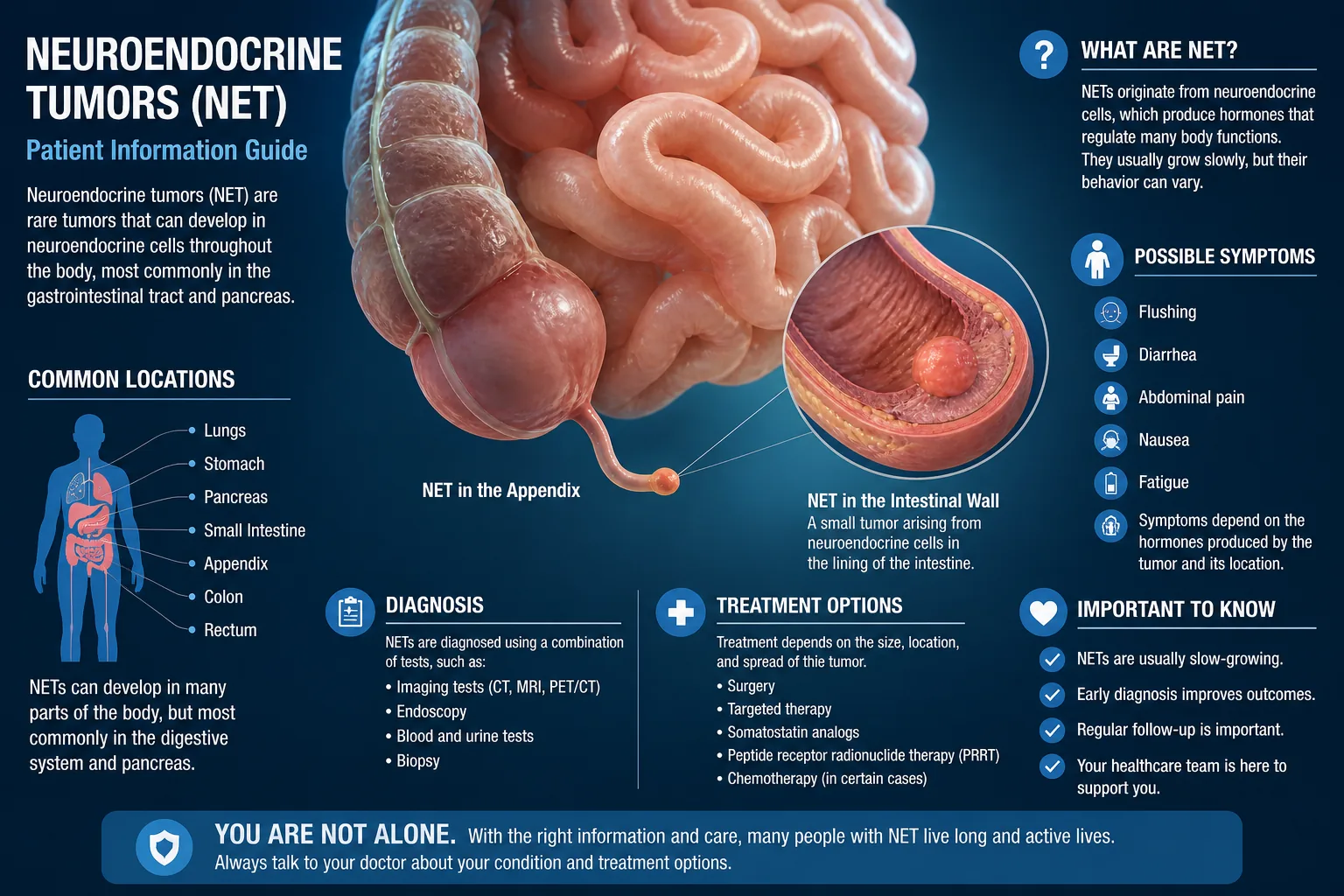
3D educational illustration: neuroendocrine tumor context

How did treatment change?

In neuroendocrine tumors (NET), treatment is separated by origin, grade, and somatostatin-receptor status. NET is not confused with NEC.

  1. Previous approach

    Somatostatin analogues were used mainly for symptom control; antiproliferative evidence and stepped targeted / PRRT options were limited.

  2. New clinical evidence

    PROMID and CLARINET antiproliferative SSA; NETTER-1/2 PRRT; RADIANT and TKI studies widened options in pNET / GI–lung NET.

  3. Current approach

    SSA, PRRT, targeted therapy, or chemotherapy is chosen by site, Ki-67 / grade, SSTR status, functionality, and prior therapies; there is no single “NET treatment.”

This summary is for patient education; individual treatment decisions depend on stage, pathology, imaging, and physician assessment.

Landmark status

Sorting

Topic filters

Showing 11 studies.

Comparison table

Select 2 or 3 studies to compare. Different endpoints are never combined in one chart.

Open this discovery in the “Discoveries That Changed Cancer Treatment” hub

Midgut neuroendocrine tumor (NET) · octreotide LAR

Gold Star — Paradigm-Changing2009Source verified

PROMID

What did the researchers want to learn?

In midgut neuroendocrine tumor (NET), does octreotide delay tumor progression?

Before

Somatostatin analogues were mostly discussed to settle hormone symptoms; randomized evidence that they slow tumor growth was limited.

Today

In selected well-differentiated metastatic midgut NET, octreotide LAR was strengthened as an antiproliferative option that mmo delmo tumor progression (TTP; must not be relabeled as PFS).

What did this study change?

In selected midgut NET, somatostatin analogs (SSA) were strengthened as an antiproliferative option.

Benefit for patients

In suitable midgut NET, potential for longer time to disease progression; overall survival superiority is not considered established by this trial.

What did the research find?

Time to progression (TTP) was about 14.3 months vs 6 months. This endpoint is not renamed progression-free survival (PFS). Survival was not conclusive in this study.

Who does this apply to?

Midgut well-differentiated NET (WD-NET). It is not automatically carried over to pancreatic / lung or to high Ki-67. It is not neuroendocrine carcinoma (NEC). TTP is not PFS is not overall survival (OS).

What did it not prove?

These results do not show that all neuroendocrine tumors respond to the same treatment, or that overall survival is definitely prolonged.

Evidence status: Current — midgut SSA TTP; OS not mature

This summary is not a treatment recommendation. Decisions depend on the type of disease, stage, general health, and your physician's assessment.

Why this study has a gold star: Foundational midgut evidence (TTP) showing an antiproliferative effect of octreotide beyond symptom control. (2009 JCO · gold-star approval 2026-10-29)

Open this discovery in the “Discoveries That Changed Cancer Treatment” hub

Enteropancreatic neuroendocrine tumor (NET) · lanreotide

Gold Star — Paradigm-Changing2014Source verified

CLARINET

What did the researchers want to learn?

Does lanreotide delay progression in neuroendocrine tumors (NET)?

Before

Phase III antiproliferative evidence that lanreotide delmos tumor progression in selected enteropancreatic NET was limited.

Today

In SSTR-positive, Ki-67 <10%, predominantly nonfunctional enteropancreatic NET, lanreotide PFS evidence became established; it is not the same study as the PROMID midgut TTP question.

What did this study change?

The antiproliferative somatostatin analog (SSA) option was strengthened in suitable somatostatin receptor-positive (SSTR+) enteropancreatic NET (EP-NET).

Benefit for patients

In suitable patients, longer time without disease progression; overall survival superiority was not shown in this trial.

What did the research find?

The progression-free rate at two years was about 65% vs 33%. No difference in survival was shown.

Who does this apply to?

SSTR+; Ki-67 <10%; predominantly non-functioning EP-NET. Do not generalize the inclusion criteria to other NETs. It is not neuroendocrine carcinoma (NEC).

What did it not prove?

Results cannot be directly generalized to high-grade neuroendocrine carcinomas or all neuroendocrine tumor types.

Evidence status: Current — SSTR+ EP-NET SSA PFS

This summary is not a treatment recommendation. Decisions depend on the type of disease, stage, general health, and your physician's assessment.

Why this study has a gold star: Foundational phase III confirming the antiproliferative effect of lanreotide in well-differentiated GEP-NET. (2014 NEJM · gold-star approval 2026-10-29)

Open this discovery in the “Discoveries That Changed Cancer Treatment” hub

Progressive midgut neuroendocrine tumor (NET) · peptide receptor radionuclide therapy (PRRT)

Gold Star — Paradigm-Changing2017 / OS 2021Source verified

NETTER-1

What did the researchers want to learn?

Is peptide receptor radionuclide therapy (PRRT) beneficial in progressive midgut NET?

Before

PRRT for progressive midgut NET was limited to selected centers; there was no randomized comparison with high-dose somatostatin analogue.

Today

In SSTR-positive progressive midgut NET, ¹⁷⁷Lu-DOTATATE became a strengthened option for progression-free survival; must not be confused with the NETTER-2 first-line high Ki-67 card.

What did this study change?

PRRT was strengthened as an option in suitable progressive SSTR-positive midgut NET.

Benefit for patients

In suitable patients, marked prolongation of time without progression; kidney and bone marrow monitoring are required. Overall survival superiority was not proven in this trial.

What did the research find?

The progression-free rate at twenty months was about 65% vs 11%. Although final overall survival was 48.0 and 36.3 months, the difference was not statistically significant (P=0.30).

Who does this apply to?

Progressive somatostatin receptor-positive (SSTR+) midgut well-differentiated NET (WD-NET). NETTER-2 is not first-line. It is not neuroendocrine carcinoma (NEC). Final overall survival (OS) not significant (P=0.30).

What did it not prove?

These results do not mean every neuroendocrine tumor patient is suitable for radionuclide therapy, or that an overall survival benefit is definitively proven.

Evidence status: Current — PRRT PFS; final OS NS

This summary is not a treatment recommendation. Decisions depend on the type of disease, stage, general health, and your physician's assessment.

Why this study has a gold star: Establishment of PRRT with randomized evidence in progressive SSTR-positive midgut NET (PFS). (2017/2021 · gold-star approval 2026-10-29)

Open this discovery in the “Discoveries That Changed Cancer Treatment” hub

Gastroenteropancreatic NET (GEP-NET) · first-line PRRT (high-grade 2 / well-differentiated grade 3) — separate from NETTER-1

Gold Star — Paradigm-Changing2024 / 2026 alt grupSource verified

NETTER-2

What did the researchers want to learn?

In selected GEP-NET with a high Ki-67, is first-line peptide receptor radionuclide therapy (PRRT) beneficial?

Before

First-line PRRT was not standard in selected high-proliferation GEP-NET; NETTER-1 progressive midgut evidence does not cover this population.

Today

In selected high G2 / well-differentiated NET G3 (Ki-67 10–55%, SSTR+) newly diagnosed advanced GEP-NET, 1L PRRT is discussed; population limits and the NETTER-1 distinction are preserved.

What did this study change?

First-line PRRT was strengthened as an option in the defined high-proliferation population; licensing / access are separate.

Benefit for patients

Longer time without progression in the defined high-proliferation group; OS is not mature.

What did the research find?

Median progression-free survival was 22.8 months vs 8.5 months (hazard ratio [HR] 0.276). Newly diagnosed advanced SSTR-positive GEP-NET; Ki-67 10–55% (high grade 2 / well-differentiated NET grade 3). NETTER-1 is not progressive midgut; no overall survival advantage is claimed.

Who does this apply to?

SSTR-positive well-differentiated GEP-NET; Ki-67 10–55%; newly diagnosed advanced. Well-differentiated NET grade 3 is not neuroendocrine carcinoma (NEC). NETTER-1 is a separate card / population. No superiority over all first-line options.

What did it not prove?

OS superiority. Superiority over all 1L options. Low Ki-67 / NEC / SSTR− disease. The NETTER-1 midgut progressive population.

Evidence status: Current — 1L PRRT PFS; OS not mature; narrow population

This summary is not a treatment recommendation. Decisions depend on the type of disease, stage, general health, and your physician's assessment.

Why this study has a gold star: Moving PRRT into the first line for selected advanced G2/G3 well-differentiated GEP-NET (PFS). (2024 Lancet · gold-star approval 2026-10-29)

Open this discovery in the “Discoveries That Changed Cancer Treatment” hub

Pancreatic neuroendocrine tumor (NET) · everolimus

Gold Star — Paradigm-Changing2011Source verified

RADIANT-3

What did the researchers want to learn?

Is everolimus beneficial in pancreatic NET?

Before

mTOR options in pNET were limited.

Today

Everolimus pNET PFS evidence became established.

What did this study change?

Everolimus became an option in progressive pancreatic NET (pNET).

Benefit for patients

Longer progression-free interval.

What did the research find?

Median progression-free survival was 11.0 months vs 4.6 months. A survival advantage is not presented as proven.

Who does this apply to?

Advanced progressive pNET. RADIANT-4 (lung / gastrointestinal) is separate. It is not neuroendocrine carcinoma (NEC). Progression-free survival (PFS) is not overall survival (OS).

What did it not prove?

OS superiority. Lung/GI NET (RADIANT-4). NEC.

Evidence status: Current — pNET everolimus PFS; no OS claim

This summary is not a treatment recommendation. Decisions depend on the type of disease, stage, general health, and your physician's assessment.

Why this study has a gold star: Phase III that opened the mTOR era with everolimus in progressive pancreatic NET (PFS). (2011 NEJM · gold-star approval 2026-10-29)

Open this discovery in the “Discoveries That Changed Cancer Treatment” hub

Lung / gastrointestinal (GI) NET · everolimus (not pancreatic NET)

Gold Star — Paradigm-Changing2016Source verified

RADIANT-4

What did the researchers want to learn?

Is everolimus beneficial in lung / GI NET?

Before

Placebo-controlled phase III evidence for everolimus in progressive nonfunctional lung or GI NET was limited; it was mixed up with pancreatic NET (RADIANT-3).

Today

In selected well-differentiated nonfunctional lung/GI NET, everolimus PFS evidence became established; the pancreatic NET question is RADIANT-3.

What did this study change?

Everolimus is discussed in selected non-functioning lung / GI NET.

Benefit for patients

In suitable patients, longer time to disease progression; overall survival superiority is not considered proven by this trial.

What did the research find?

Median progression-free survival was 11.0 months vs 3.9 months. No survival advantage is claimed. Pancreatic NET is RADIANT-3.

Who does this apply to?

Advanced progressive non-functioning lung / GI well-differentiated NET (WD-NET). Pancreatic is not this card (RADIANT-3). It is not neuroendocrine carcinoma (NEC). Progression-free survival (PFS) is not overall survival (OS).

What did it not prove?

This research does not show that the same result would be obtained in all pancreatic neuroendocrine tumors or in poorly differentiated neuroendocrine carcinomas.

Evidence status: Current — lung/GI everolimus PFS; ≠pNET

This summary is not a treatment recommendation. Decisions depend on the type of disease, stage, general health, and your physician's assessment.

Why this study has a gold star: Everolimus PFS evidence in advanced progressive nonfunctional gastrointestinal and lung NET (not pNET). (2016 Lancet · gold-star approval 2026-10-29)

Open this discovery in the “Discoveries That Changed Cancer Treatment” hub

Pancreatic neuroendocrine tumor (NET) · sunitinib (SUNNET)

Gold Star — Paradigm-Changing2011Source verified

SUNNET

What did the researchers want to learn?

Is sunitinib beneficial in pancreatic NET?

Before

Anti-angiogenic TKI evidence in pNET was limited.

Today

Sunitinib pNET PFS evidence became established.

What did this study change?

Sunitinib became an option in progressive pancreatic NET (pNET).

Benefit for patients

Longer progression-free interval — toxicity cost is explicit.

What did the research find?

Median progression-free survival was 11.4 months vs 5.5 months. Toxicity and the uncertainty about overall survival are read together.

Who does this apply to?

Advanced progressive well-differentiated pNET. Early closure; toxicity; overall survival (OS) uncertain. It is not neuroendocrine carcinoma (NEC).

What did it not prove?

Definitive mature OS superiority. NEC. Equivalence to cabozantinib (CABINET).

Evidence status: Current — pNET sunitinib PFS; toxicity + OS uncertain

This summary is not a treatment recommendation. Decisions depend on the type of disease, stage, general health, and your physician's assessment.

Why this study has a gold star: Sunitinib PFS evidence in advanced pancreatic NET (anti-angiogenic TKI). (2011 NEJM · gold-star approval 2026-10-29)

Open this discovery in the “Discoveries That Changed Cancer Treatment” hub

Advanced neuroendocrine tumor (NET) · cabozantinib

Gold Star — Paradigm-Changing2024/2025Source verified

CABINET

What did the researchers want to learn?

Is cabozantinib beneficial in previously treated NET?

Before

TKI options after PRRT/targeted therapy were limited.

Today

Cabozantinib PFS option added; US FDA approval 26 March 2025 (access is local).

What did this study change?

Cabozantinib was strengthened as an option in selected second-line or later pNET / epNET.

Benefit for patients

Longer progression-free interval — toxicity cost is explicit.

What did the research find?

Pancreatic NET (pNET) 13.8 vs 4.4 months; extra-pancreatic NET (epNET) 8.4 vs 3.9 months (NEJM). No overall survival advantage; grade ≥3 side effects were frequent.

Who does this apply to?

Previously treated well-differentiated pNET or epNET (separate). Neuroendocrine carcinoma (NEC) excluded. NEJM medians are not to be mixed with FDA label medians. It is not CapTem.

What did it not prove?

OS superiority. CapTem equivalence. NEC. A fundamental paradigm shift.

Evidence status: Current — milestone; Gr≥3 high; OS not mature; FDA 2025-03-26

This summary is not a treatment recommendation. Decisions depend on the type of disease, stage, general health, and your physician's assessment.

Why this study has a gold star: Cabozantinib PFS option in previously treated pNET/epNET — clinical milestone (high toxicity; FDA 26 March 2025). (NEJM · FDA 2025-03-26 · gold star retained 2026-10-29)

Pancreatic neuroendocrine tumor (NET) · CapTem

Emerging Evidence2023Source verified

ECOG-ACRIN E2211

What did the researchers want to learn?

Is CapTem (capecitabine + temozolomide) better than temozolomide (TEM) alone in pancreatic NET?

Before

CapTem was mostly experience-based.

Today

A randomized phase II reference was established.

What did this study change?

CapTem is discussed in selected pancreatic NET (pNET); the evidence hierarchy is phase II.

Benefit for patients

Response / PFS potential — uncertainty must be discussed openly.

What did the research find?

Progression was delayed in the interim analysis; in the final analysis the certainty of the difference decreases. There is no survival advantage.

Who does this apply to?

pNET. It is not CABINET. It is not neuroendocrine carcinoma (NEC).

What did it not prove?

Definitive phase III PFS/OS superiority.

Evidence status: Phase II — CapTem; final PFS uncertain

This summary is not a treatment recommendation. Decisions depend on the type of disease, stage, general health, and your physician's assessment.

Pancreatic neuroendocrine tumor (NET) · treatment sequencing

Emerging Evidence2025Source verified

SEQTOR

What did the researchers want to learn?

In pancreatic NET, should everolimus come first, or chemotherapy?

Before

Sequencing evidence was limited.

Today

No PFS winner; there is an ORR nuance.

What did this study change?

The sequence is individualized; the need for an objective response rate (ORR) may bring streptozocin / 5-fluorouracil (STZ/5-FU) forward.

Benefit for patients

Realistic sequencing expectations.

What did the research find?

There was no advantage of one sequence in terms of progression; the response rate was higher in the chemotherapy-first arm.

Who does this apply to?

Well-differentiated pancreatic NET (panNET). It is not neuroendocrine carcinoma (NEC).

What did it not prove?

A single superior sequence for PFS.

Evidence status: Sequencing — no PFS superiority; ORR nuance

This summary is not a treatment recommendation. Decisions depend on the type of disease, stage, general health, and your physician's assessment.

Gastroenteropancreatic NET (GEP-NET) · ¹⁷⁷Lu-edotreotide vs everolimus

Under review for paradigm-changing status2026Source verified

COMPETE

What did the researchers want to learn?

Is edotreotide peptide receptor radionuclide therapy (PRRT) better than everolimus?

Before

Head-to-head phase III of PRRT vs everolimus was limited.

Today

Edotreotide PFS evidence added — agent, OS, and access distinctions are required; star pending.

What did this study change?

Edotreotide vs everolimus is discussed in SSTR-positive grade 1–2 disease; access / licensing are separate — the star was put on hold.

Benefit for patients

Potential for longer progression-free interval (selected).

What did the research find?

Median progression-free survival was 23.9 months vs 14.1 months (hazard ratio 0.67). Grade 3–4 drug-related side effects ≈18% vs 40%. Overall survival or licensing is not a basis for a gold star.

Who does this apply to?

SSTR-positive grade 1–2; Ki-67 ≤20%. Dotatate is not edotreotide. It is not neuroendocrine carcinoma (NEC). Gold star pending_review.

What did it not prove?

Equivalence to Dotatate. Mandatory mature OS. Universal approval/access. NEC.

Evidence status: Lancet 2026 PFS — pending_review (OS/approval/access)

Gold-star candidate — awaiting editorial review: PFS positive; OS maturity, approval/access, and Dotatate distinction — star held. Stars are never assigned automatically.

This summary is not a treatment recommendation. Decisions depend on the type of disease, stage, general health, and your physician's assessment.

Do these trials ask the same question?

NET – NEC

No. This atlas is for well-differentiated NET. Poorly differentiated NEC is a separate disease; NET results do not transfer to NEC. WD-NET G3 ≠ NEC.

PROMID – CLARINET

Both provide SSA antiproliferative evidence, but populations differ (midgut TTP vs SSTR+ EP-NET Ki-67 <10% PFS).

NETTER-1 – NETTER-2

NETTER-1 progressive midgut (mostly after SSA). NETTER-2 selected 1L high G2/WD-G3 (Ki-67 10–55%, SSTR+). Not the same card.

NETTER Dotatate – COMPETE edotreotide

Different radiopharmaceutical peptide preparations. Efficacy/access do not transfer automatically.

RADIANT-3 – RADIANT-4

RADIANT-3 pNET; RADIANT-4 lung/GI nonfunctional. Not the same localization.

CABINET – E2211

CABINET is cabozantinib TKI. E2211 is CapTem chemotherapy. There is no name similarity; they are not mixed up.

PFS – OS

Prolonged PFS/TTP does not mean OS superiority. NETTER-1 final OS NS is an example.

Medical editor's note

Each study was designed for a specific patient group, treatment arm, and primary endpoint. Results should not be automatically generalized to other diseases or to all patients. This atlas is educational and is not a treatment recommendation.

Evidence

Scientific sources

Show sources · 4

NET landmark atlas: PROMID, CLARINET, NETTER-1/2, RADIANT-3/4, sunitinib pNET, CABINET, E2211, SEQTOR, COMPETE (177Lu-edotreotide; Lancet 2026). NET≠NEC; WD-G3≠NEC; Dotatate≠edotreotide; PFS≠OS. No automatic gold stars.

  1. NCCN Guidelines — Neuroendocrine and Adrenal TumorsNCCN · Current versionOpen source
  2. NETTER-1 — 177Lu-Dotatate versus high-dose octreotide in midgut neuroendocrine tumors (RCT)NEJM (clinical study; not a guideline) · 2017 · DOI: 10.1056/NEJMoa1607427Open source
  3. CLARINET — Lanreotide versus placebo in enteropancreatic neuroendocrine tumors (RCT)NEJM (clinical study; not a guideline) · 2014 · DOI: 10.1056/NEJMoa1316158Open source
  4. ESMO Gastrointestinal Cancer GuidelinesESMO · Living / eUpdateOpen source

Source list last checked: 31 October 2026. (Page content review date may appear separately above.)