Disease-specific landmark atlas · Pancreas

Pancreatic Cancer Landmark Atlas

Landmark studies on adjuvant mFOLFIRINOX, neoadjuvant strategies, borderline resectable disease, BRCA maintenance, NALIRIFOX, and 2026 RAS-targeted research (RASolute 302).

DFS, OS, pCR, cCR, and similar endpoints are not interchangeable. Gold stars are never assigned automatically. Numeric cards are verified summaries of primary publications. A patient summary is not a treatment recommendation.

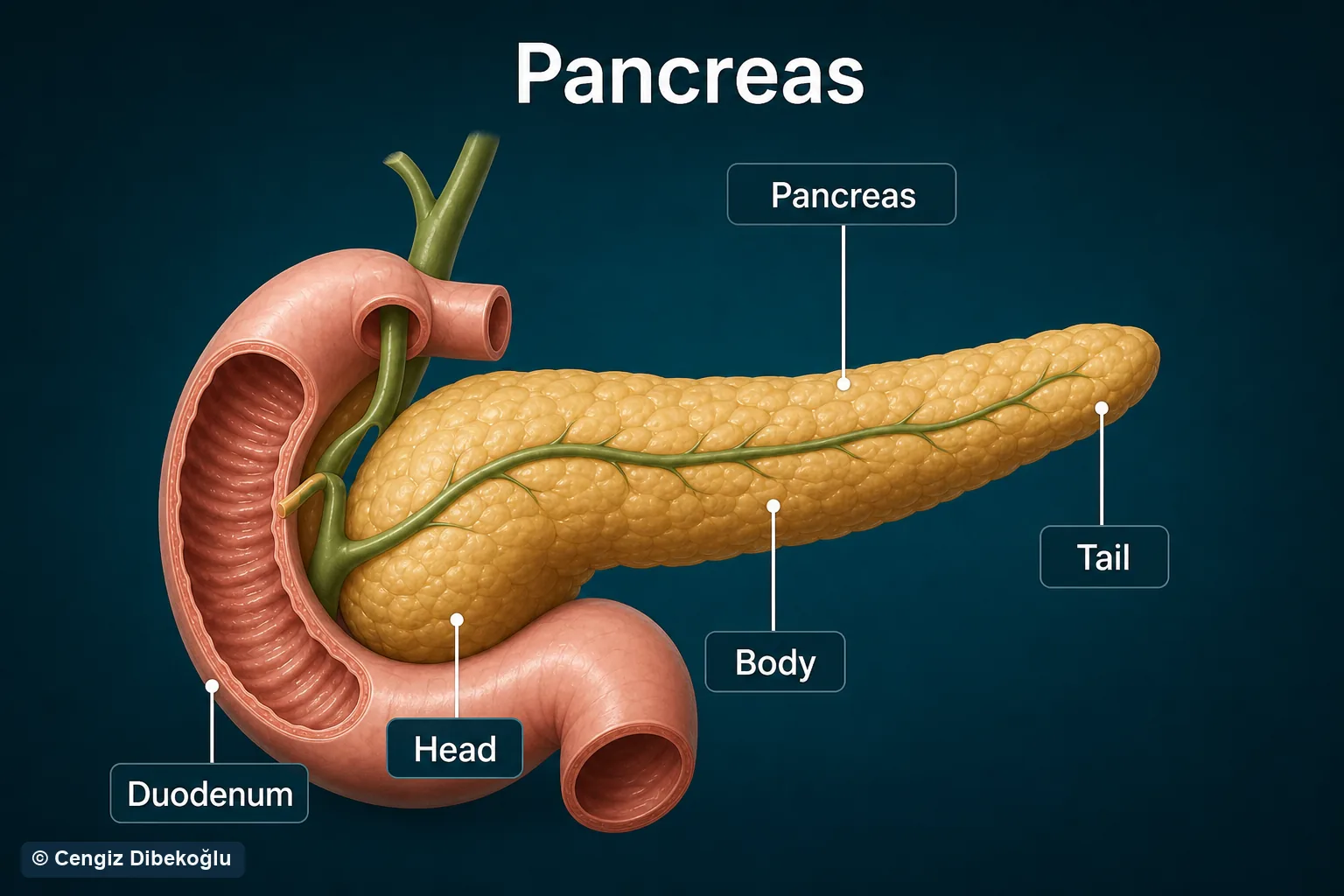
3D educational illustration: pancreas anatomy

How did treatment change?

In pancreatic cancer, adjuvant and perioperative regimens have changed a “surgery-only” approach in selected patients.

  1. Previous approach

    In resectable disease the main emphasis was surgery; effective adjuvant regimens were limited.

  2. New clinical evidence

    Studies such as ESPAC and PRODIGE strengthened the place of more intensive adjuvant / perioperative regimens; patient selection remained critical.

  3. Current approach

    Surgical timing and systemic therapy are planned together by stage, performance status, and molecular features; not every regimen suits every patient.

This summary is for patient education; individual treatment decisions depend on stage, pathology, imaging, and physician assessment.

Landmark status

Sorting

Topic filters

Showing 14 studies.

Comparison table

Select 2 or 3 studies to compare. Different endpoints are never combined in one chart.

Pancreatic cancer · postoperative gemcitabine

Foundational Evidence2007 / long-termSource verified

CONKO-001

What did the researchers want to learn?

After pancreatic cancer surgery, does gemcitabine chemotherapy prolong the time before the disease comes back compared with observation alone?

Before

The benefit of adjuvant gemcitabine in resected pancreatic cancer was not yet clear.

Today

Adjuvant gemcitabine became one of the foundational standards in selected patients.

What did this study change?

It became one of the key pieces of evidence supporting the role of drug treatment after pancreatic cancer surgery.

Benefit for patients

Relevant to patients with resected pancreatic adenocarcinoma.

What did the research find?

Postoperative gemcitabine clearly prolonged the time before the disease came back (median 13.4 months and 6.7 months). In the long-term analysis, a survival benefit was also reported (median 22.8 months and 20.2 months).

Who does this apply to?

More effective combination treatments are available today; the results cannot be applied one-to-one to today's standard regimens.

What did it not prove?

Does not prove that it replaces mFOLFIRINOX or resolves every margin-positive scenario.

This summary is not a treatment recommendation. Decisions depend on the type of disease, stage, general health, and your physician's assessment.

Operated pancreatic cancer · postoperative combination chemotherapy

Foundational Evidence2017 / long-term JCO 2024Source verified

ESPAC-4

What did the researchers want to learn?

After pancreatic cancer surgery, is two-drug chemotherapy (gemcitabine + capecitabine) better than gemcitabine alone?

Before

Single-agent adjuvant gemcitabine was common.

Today

Gemcitabine + capecitabine strengthened the adjuvant option in selected patients.

What did this study change?

It showed the benefit of postoperative combination treatment.

Benefit for patients

Relevant to patients with resected pancreatic cancer.

What did the research find?

In the first publication, median overall survival (OS) was 28.0 vs 25.5 months; at long-term follow-up 31.6 vs 28.4 months (different time points). GemCap (gemcitabine plus capecitabine) was not compared directly with mFOLFIRINOX.

Who does this apply to?

ESPAC-4 did not directly compare GemCap with modified FOLFIRINOX. Current choice is made according to the patient's condition and later studies.

What did it not prove?

Does not show head-to-head superiority over mFOLFIRINOX.

This summary is not a treatment recommendation. Decisions depend on the type of disease, stage, general health, and your physician's assessment.

Open this discovery in the “Discoveries That Changed Cancer Treatment” hub

Pancreatic cancer · postoperative chemotherapy

Gold Star — Paradigm-Changing2018 / 5y 2022Source verified

PRODIGE-24 / CCTG PA.6

What did the researchers want to learn?

In pancreatic cancer removed by surgery, does the four-drug regimen mFOLFIRINOX prolong survival compared with gemcitabine?

Before

While adjuvant gemcitabine was debated as the standard, intensive regimens were being investigated.

Today

In patients with suitable performance status, adjuvant mFOLFIRINOX became one of the preferred options.

What did this study change?

In selected patients in good condition, adjuvant mFOLFIRINOX became a preferred option in many guidelines.

Benefit for patients

Relevant to surgically treated pancreatic cancer patients with suitable general condition.

What did the research find?

In the first publication, median overall survival (OS) was 54.4 vs 35.0 months; at long-term follow-up it was 53.5 vs 35.5 months (different time points). Disease-free survival (DFS) and OS both improved; the regimen is intensive and may not be suitable for every patient.

Who does this apply to?

Applies to patients with adequate general condition after surgery who meet the eligibility criteria. It is not generalized to metastatic / inoperable disease or to neoadjuvant borderline-resectable questions.

What did it not prove?

Does not mean an intensive regimen is mandatory for all patients; the toxicity burden is high.

This summary is not a treatment recommendation. Decisions depend on the type of disease, stage, general health, and your physician's assessment.

Why this study has a gold star: Made adjuvant mFOLFIRINOX an important standard for patients with suitable performance status. (2018–2022 / editorial 2026-11)

Operated pancreatic cancer · gemcitabine + nab-paclitaxel

Emerging Evidence2022 / OS updateSource verified

APACT

What did the researchers want to learn?

Is giving gemcitabine together with nab-paclitaxel after surgery better than gemcitabine alone?

Before

Adjuvant nab-paclitaxel + gemcitabine looked promising.

Today

Primary DFS superiority was not met in this trial; regimen selection is cautious.

What did this study change?

It showed that a negative primary endpoint and later analyses need to be interpreted separately; it cannot be said to have changed the routine standard.

Benefit for patients

Relevant to patients with resected pancreatic cancer.

What did the research find?

The primary disease-free survival (DFS) endpoint, based on independent assessment, was not met (19.4 vs 18.8 months). Later overall survival (OS) findings do not erase this primary result.

Who does this apply to?

When the primary endpoint is not met, the standard should not be set on the basis of secondary analyses. It cannot be compared directly with PRODIGE-24.

What did it not prove?

Does not show that mFOLFIRINOX or gemcitabine–capecitabine is ineffective.

This summary is not a treatment recommendation. Decisions depend on the type of disease, stage, general health, and your physician's assessment.

Resectable / borderline resectable pancreatic cancer · chemoradiotherapy before surgery

Foundational Evidence2022 (long-term)Source verified

PREOPANC

What did the researchers want to learn?

In operable or borderline operable pancreatic cancer, is gemcitabine-based chemoradiotherapy before surgery better than going straight to surgery?

Before

Preoperative chemoradiotherapy in resectable pancreas disease was debated.

Today

In selected patients, the neoadjuvant approach gave a DFS signal; OS interpretation is limited.

What did this study change?

It supported the importance of preoperative treatment strategies.

Benefit for patients

Relevant to patients with borderline resectable pancreatic cancer.

What did the research find?

In the long term, an overall survival (OS) benefit in the overall population (hazard ratio [HR] 0.73; 5-year 20.5% vs 6.5%). In the borderline subgroup HR 0.67 (p=0.045); in the resectable subgroup HR 0.79 (p=0.23, not significant) — read separately.

Who does this apply to?

The PREOPANC protocol is not the same as all of today's neoadjuvant approaches; resectable is not the same as borderline.

What did it not prove?

Does not mean neoadjuvant therapy is mandatory for every patient or equivalent to mFOLFIRINOX.

This summary is not a treatment recommendation. Decisions depend on the type of disease, stage, general health, and your physician's assessment.

Resectable / borderline resectable pancreatic cancer · FOLFIRINOX before surgery

Emerging Evidence2025Source verified

PREOPANC-2

What did the researchers want to learn?

In operable or borderline operable pancreatic cancer, is total FOLFIRINOX before surgery better than gemcitabine-based chemoradiotherapy?

Before

Different neoadjuvant regimens were being compared.

Today

Regimen choice sought clarity with randomized data; subgroups are read cautiously.

What did this study change?

It showed that more intensive treatment on its own does not guarantee a better result.

Benefit for patients

Relevant to patients planned for neoadjuvant pancreatic cancer treatment.

What did the research find?

The primary overall survival (OS) superiority could not be shown (21.9 vs 21.3 months; hazard ratio [HR] 0.88; p=0.32; modified intention-to-treat [mITT] n=369). This does not mean that neoadjuvant treatment is unnecessary or that the two are equivalent in every situation.

Who does this apply to?

It has not been proven that FOLFIRINOX is equivalent to chemoradiotherapy in all situations or that neoadjuvant treatment is unnecessary. Strategies change together.

What did it not prove?

Not a claim of definitive superiority in all subgroups.

This summary is not a treatment recommendation. Decisions depend on the type of disease, stage, general health, and your physician's assessment.

Resectable pancreatic head cancer · short-course FOLFIRINOX before surgery

Emerging Evidence2024Source verified

NORPACT-1

What did the researchers want to learn?

In pancreatic head cancer that can be operated on, is short-course FOLFIRINOX before surgery better than going straight to surgery?

Before

Superiority of neoadjuvant FOLFIRINOX was uncertain.

Today

In this trial the expected neoadjuvant superiority was not clarified; choice is individualized.

What did this study change?

It emphasized that directly operable and borderline operable disease should not be managed in the same way.

Benefit for patients

Relevant to patients with resectable pancreatic cancer.

What did the research find?

The study did not show a survival advantage for preoperative treatment; in some analyses results favored upfront surgery (median 25.1 months and 38.5 months; proportion of patients alive at 18 months 60% and 73%).

Who does this apply to?

Treatment completion rates and the treatment sequence are important in interpreting the results. It is an early-phase (phase II) study; it does not set a definitive standard.

What did it not prove?

Does not cancel adjuvant mFOLFIRINOX evidence.

This summary is not a treatment recommendation. Decisions depend on the type of disease, stage, general health, and your physician's assessment.

Borderline resectable pancreatic cancer · preoperative treatment

Emerging Evidence2023Study / result verification pending

ESPAC-5

What did the researchers want to learn?

In borderline operable pancreatic cancer, how do different short-course treatments before surgery perform compared with upfront surgery?

Before

Neoadjuvant strategies in borderline resectable disease were diversifying.

Today

Feasibility of short neoadjuvant options was discussed; there is no single definitive standard regimen.

What did this study change?

It is one of the pieces of evidence supporting the approach of drug treatment first in borderline operable disease.

Benefit for patients

Relevant to patients with borderline resectable pancreatic cancer.

What did the research find?

One-year survival findings favoring preoperative treatment strategies were reported. No definite superiority of one regimen among the treatment arms can be stated.

Who does this apply to?

Because of the small number of patients and the different treatment arms, it cannot be claimed that a particular regimen is superior.

What did it not prove?

Not directly generalized to the large adjuvant PRODIGE-24 population.

This summary is not a treatment recommendation. Decisions depend on the type of disease, stage, general health, and your physician's assessment.

Borderline resectable pancreatic cancer · adding radiotherapy

Emerging Evidence2022Study / result verification pending

Alliance A021501

What did the researchers want to learn?

Does adding short-course intensive radiotherapy to preoperative mFOLFIRINOX chemotherapy improve outcomes?

Before

Neoadjuvant mFOLFIRINOX ± RT was being investigated in borderline disease.

Today

The contribution of added RT was not clarified in this design; the systemic therapy backbone matters.

What did this study change?

It showed that adding radiotherapy in borderline operable disease does not automatically give a better result.

Benefit for patients

Relevant to patients with borderline resectable pancreatic cancer.

What did the research find?

The arm with radiotherapy added did not meet the prespecified efficacy criterion; the chemotherapy arm showed more favorable results.

Who does this apply to?

The early-phase (phase II) design, the early closure of the arm and patient selection must be taken into account; it does not set a definitive standard.

What did it not prove?

Does not resolve adjuvant or metastatic questions.

This summary is not a treatment recommendation. Decisions depend on the type of disease, stage, general health, and your physician's assessment.

Locally advanced, inoperable pancreatic cancer · chemoradiotherapy

Emerging Evidence2016Source verified

LAP07

What did the researchers want to learn?

If the disease has not progressed after first chemotherapy, does chemoradiotherapy prolong survival compared with continuing chemotherapy?

Before

The benefit of chemoradiotherapy after chemotherapy in locally advanced pancreas disease was uncertain.

Today

Planned chemoradiotherapy did not show OS superiority; local control is discussed separately.

What did this study change?

It showed that control of the tumor in the same area and survival are not the same outcome.

Benefit for patients

Relevant to patients with locally advanced pancreatic cancer.

What did the research find?

No significant advantage in survival could be shown (median about 15.2 months and around 16.5 months, no significant difference); that is, the main goal of the study was not met. Some benefits were reported in terms of control of the tumor in the same area.

Who does this apply to?

Regimens different from today's systemic treatments were used. It does not cover the same patient group as the preoperative studies conducted in operable disease.

What did it not prove?

Does not cover selected local therapy or ablation scenarios.

This summary is not a treatment recommendation. Decisions depend on the type of disease, stage, general health, and your physician's assessment.

Metastatic pancreatic cancer · germline BRCA · olaparib maintenance

Emerging Evidence2019Source verified

POLO

What did the researchers want to learn?

In metastatic pancreatic cancer with an inherited BRCA gene alteration that has not progressed on platinum-containing chemotherapy, is olaparib maintenance treatment beneficial?

Before

There was no maintenance PARP inhibitor for gBRCA-mutated metastatic pancreas disease.

Today

Olaparib maintenance showed a PFS benefit in selected gBRCA patients.

What did this study change?

It increased the importance of germline BRCA testing in treatment selection.

Benefit for patients

Relevant to platinum-responsive, gBRCA-mutated metastatic pancreatic cancer patients.

What did the research find?

The time before the disease progressed was prolonged (median 7.4 months and 3.8 months; hazard ratio 0.53). A survival advantage, however, could not be shown.

Who does this apply to?

Valid for a very selected genetic and clinical patient group; it cannot be compared with NAPOLI-3 because it has a different purpose.

What did it not prove?

Not generalized to BRCA wild-type or to an adjuvant indication; OS interpretation is cautious.

This summary is not a treatment recommendation. Decisions depend on the type of disease, stage, general health, and your physician's assessment.

Metastatic pancreatic cancer · first-line NALIRIFOX

Foundational Evidence2023Source verified

NAPOLI-3

What did the researchers want to learn?

In previously untreated metastatic pancreatic cancer, is NALIRIFOX chemotherapy better than gemcitabine plus nab-paclitaxel?

Before

Nab-paclitaxel/gemcitabine was common in first-line metastatic pancreas disease.

Today

NALIRIFOX was strengthened as a first-line option in selected patients.

What did this study change?

It supported a new first-line combination option in metastatic pancreatic cancer.

Benefit for patients

Relevant to patients with metastatic pancreatic adenocarcinoma.

What did the research find?

Median overall survival (OS) 11.1 vs 9.2 months (hazard ratio [HR] 0.83); median progression-free survival (PFS) 7.4 vs 5.6 months. It is a metastatic first-line population; NALIRIFOX is not the same as mFOLFIRINOX.

Who does this apply to?

Belongs to the metastatic population; it is not generalized to adjuvant / neoadjuvant settings. NALIRIFOX is not the same regimen as modified FOLFIRINOX. It is not the same question as POLO.

What did it not prove?

It is not the same regimen as adjuvant mFOLFIRINOX; does not mean it is mandatory for every patient.

This summary is not a treatment recommendation. Decisions depend on the type of disease, stage, general health, and your physician's assessment.

Previously treated metastatic pancreatic cancer · RAS-targeted daraxonrasib

Emerging Evidence2026Source verified

RASolute 302

What did the researchers want to learn?

In previously treated metastatic pancreatic cancer, does oral daraxonrasib improve survival and the time before the disease progresses compared with chemotherapy chosen by the doctor?

Before

RAS inhibitors were at the research stage in pancreas disease.

Today

RAS-targeted approaches showed promise in selected mutations; maturity is being followed.

What did this study change?

It showed that RAS-targeted therapy can prolong survival in previously treated metastatic pancreatic cancer; approval was obtained in the United States for some groups.

Benefit for patients

Relevant to patients with certain RAS-mutated pancreatic cancers.

What did the research find?

Survival and progression-free time improved significantly both in the group with a RAS G12 mutation and in all patients. In all patients, median survival was 13.2 months and 6.7 months (hazard ratio 0.40), progression-free time was 7.2 months and 3.6 months (hazard ratio 0.49), and the tumor response rate was 31.6% and 11.2%.

Who does this apply to?

It is an open-label study (patient and doctor know the treatment); it was not conducted in operable disease and long-term follow-up is needed. It does not mean a cure or a replacement for surgery; licensing and access in Turkey must be checked separately.

What did it not prove?

Does not yet prove that it replaces standard first-line therapy.

This summary is not a treatment recommendation. Decisions depend on the type of disease, stage, general health, and your physician's assessment.

Metastatic pancreatic cancer · MTAP loss and RAS mutation · early-phase combination

Emerging Evidence2026 (ESMO)Study / result verification pending

TNG462-C102

What did the researchers want to learn?

In metastatic pancreatic cancer with loss of the MTAP gene and a RAS mutation, does the combination of vopimetostat and daraxonrasib have an effect on the tumor?

Before

Synthetic lethality approaches in MTAP-loss tumors are early-stage.

Today

Early-phase findings generate hypotheses; they are not standard therapy.

What did this study change?

It shows the potential of a dual-targeted approach in MTAP-deleted pancreatic cancer; it is not evidence of superiority over standard treatment or chemotherapy. Larger studies are planned.

Benefit for patients

Relevant to selected molecular-subgroup research patients.

What did the research find?

In 22 evaluable patients, a tumor response rate of 82% (18/22; all partial responses) and a disease control rate of 100% were reported. Median progression-free survival has not yet been reached. The 29 treated patients and the 22 evaluable patients should not be confused.

Who does this apply to?

Because of the small number of patients, the lack of a control group and the short follow-up, the results are early; no survival advantage has been shown. An 82% response does not mean an 82% cure, and it should not yet be presented as standard treatment.

What did it not prove?

Not phase III efficacy or licensing evidence.

This summary is not a treatment recommendation. Decisions depend on the type of disease, stage, general health, and your physician's assessment.

Atlas comparison guide

CONKO-001 – ESPAC-4 – PRODIGE-24

Shows the evolution of adjuvant therapy: observation→gemcitabine (CONKO), GemCap (ESPAC-4), mFOLFIRINOX in fit patients (PRODIGE-24). Population selection and toxicity increase; this is an indirect comparison.

APACT – PRODIGE-24

Different adjuvant regimens; not a head-to-head study. APACT did not meet its primary independent DFS endpoint; PRODIGE-24 showed DFS/OS superiority. Results cannot be placed on the same scale.

PREOPANC – PREOPANC-2 – NORPACT-1

Preoperative strategies. PREOPANC: gemcitabine-CRT vs surgery first (long-term OS benefit). PREOPANC-2: FOLFIRINOX vs gemcitabine-CRT (no OS difference). NORPACT-1: no neoadjuvant FOLFIRINOX superiority in primarily resectable head cancer. Patient groups differ.

ESPAC-5 – Alliance A021501

Borderline resectable disease. ESPAC-5 supports short neoadjuvant strategies (phase II). A021501 shows that adding RT to mFOLFIRINOX does not automatically confer benefit. Claims of regimen superiority are limited.

LAP07 – neoadjuvant trials

Locally advanced (nonsurgical) and resectable/borderline populations must be separated. In LAP07, CRT may affect local control but did not show OS superiority.

POLO – NAPOLI-3

Different aims in metastatic disease: POLO maintenance after platinum in germline BRCA (PFS; no OS); NAPOLI-3 first-line NALIRIFOX (OS). Maintenance and first-line cannot be compared.

RASolute 302 – TNG462-C102

Both are 2026 RAS-context trials but evidence levels differ. RASolute 302: randomized phase III, OS/PFS superiority in previously treated mPDAC (primary RAS G12; ITT separate). TNG462-C102: nonrandomized phase I/II, high ORR in selected MTAP-loss patients; no OS superiority. ORR vs OS, and phase I/II vs phase III, cannot be compared directly.

NAPOLI-3 – RASolute 302

NAPOLI-3 is treatment-naive first-line NALIRIFOX; RASolute 302 is RAS-targeted oral therapy in a previously treated second-line context. Line and population differ — not head-to-head.

Medical editor's note

Each study was designed for a specific patient group, treatment arm, and primary endpoint. Results should not be automatically generalized to other diseases or to all patients. This atlas is educational and is not a treatment recommendation.

Evidence

Scientific sources

Show sources · 6

Pancreatic cancer landmark atlas: CONKO-001, ESPAC-4, PRODIGE-24, APACT, PREOPANC, PREOPANC-2, NORPACT-1, ESPAC-5, Alliance A021501, LAP07, POLO, NAPOLI-3. OS/DFS/PFS are not interchangeable; numeric cards live only on this page.

  1. Pancreatic cancer: ESMO Clinical Practice Guideline for diagnosis, treatment and follow-upESMO · 2023 · DOI: 10.1016/j.annonc.2023.08.009Open source
  2. NCCN Guidelines — Pancreatic AdenocarcinomaNCCN · Current versionOpen source
  3. PRODIGE 24 / CCTG PA.6 — FOLFIRINOX versus gemcitabine after resection of pancreatic cancer (RCT)NEJM (clinical study; not a guideline) · 2018 · DOI: 10.1056/NEJMoa1809775Open source
  4. PREOPANC — Neoadjuvant chemoradiotherapy versus upfront surgery for resectable and borderline resectable pancreatic cancer (RCT)Journal of Clinical Oncology (clinical study; not a guideline) · 2022 · DOI: 10.1200/JCO.21.02233Open source
  5. NORPACT-1 — Neoadjuvant FOLFIRINOX versus upfront surgery for resectable pancreatic head cancer (RCT)Lancet Gastroenterology & Hepatology (clinical study; not a guideline) · 2024 · DOI: 10.1016/S2468-1253(23)00405-3Open source
  6. ESMO Gastrointestinal Cancer GuidelinesESMO · Living / eUpdateOpen source

Source list last checked: 31 October 2026. (Page content review date may appear separately above.)