Disease-specific landmark atlas · Peritoneal / HIPEC

Peritoneal Metastasis / HIPEC Landmark Atlas

CRS and HIPEC are read separately. Covers colorectal, ovarian, and gastric peritoneal disease, including PRODIGE 7, COLOPEC (preventive HIPEC; not the same question as PRODIGE 7), OVHIPEC-1, GASTRIPEC-I, CYTO-CHIP, and OVHIPEC-2.

DFS, OS, pCR, cCR, and similar endpoints are not interchangeable. Gold stars are never assigned automatically. Numeric cards are verified summaries of primary publications. A patient summary is not a treatment recommendation.

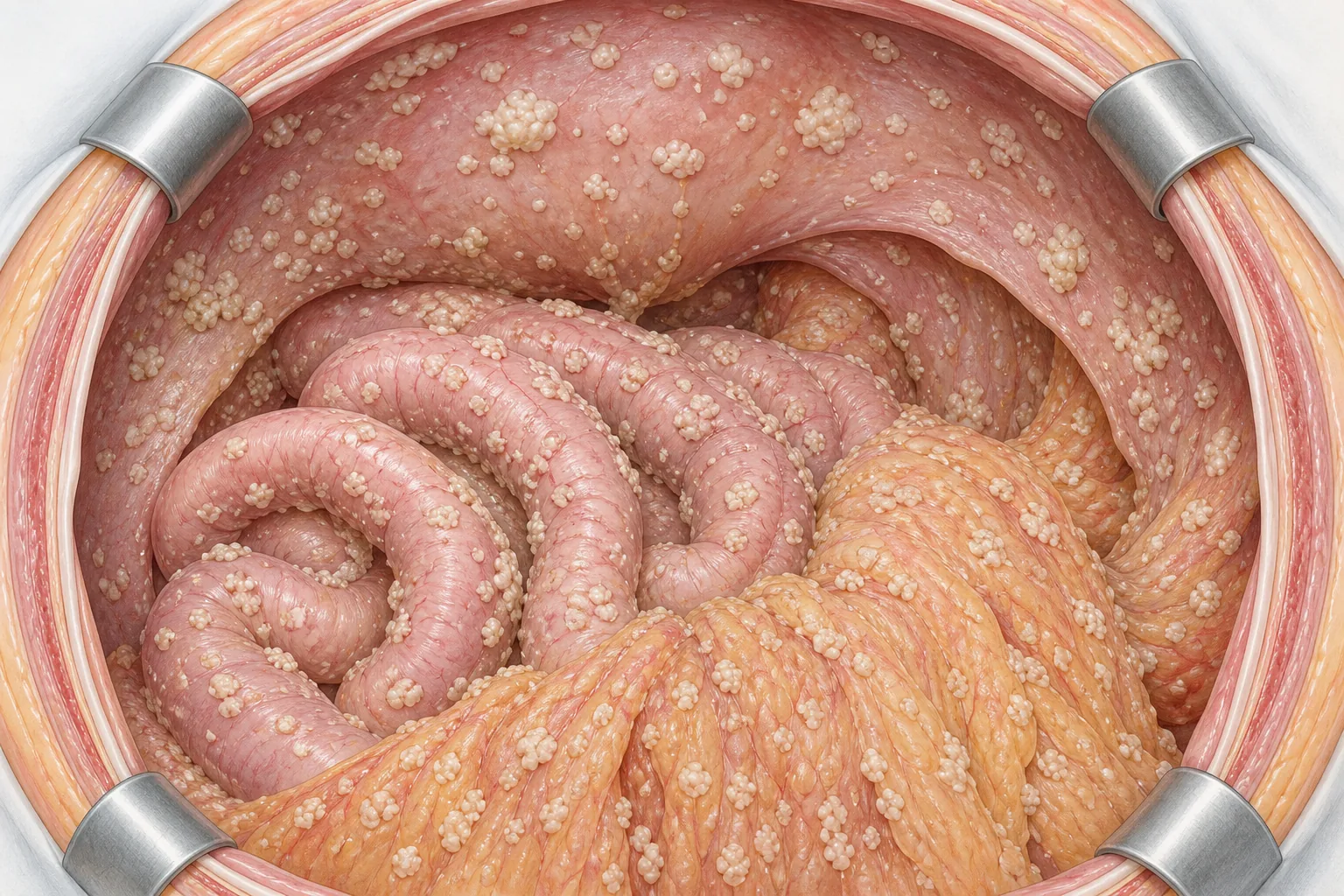
3D educational illustration: peritoneal disease and CRS/HIPEC context

How did treatment change?

In peritoneal metastasis, the cytoreduction and HIPEC debate is read more carefully in light of negative and selectively positive evidence.

  1. Previous approach

    In selected centers, CRS+HIPEC could be presented more broadly as a promising option.

  2. New clinical evidence

    Studies such as PRODIGE 7 showed that HIPEC does not give the same benefit in every population; patient selection and primary tumor type remained critical.

  3. Current approach

    Multidisciplinary decisions are made by primary disease, PCI, likelihood of complete cytoreduction, and systemic options; HIPEC is not an automatic standard.

This summary is for patient education; individual treatment decisions depend on stage, pathology, imaging, and physician assessment.

Landmark status

Sorting

Topic filters

Showing 8 studies.

Comparison table

Select 2 or 3 studies to compare. Different endpoints are never combined in one chart.

Open this discovery in the “Discoveries That Changed Cancer Treatment” hub

Colorectal peritoneal metastasis · cytoreductive surgery (CRS) ± oxaliplatin HIPEC

Gold Star — Paradigm-Changing2021Source verified

PRODIGE 7

What did the researchers want to learn?

In colorectal spread to the peritoneum (abdominal lining), after the tumor has been cleared by surgery, does adding short-course oxaliplatin hyperthermic intraperitoneal chemotherapy (HIPEC) prolong life?

Before

In colorectal peritoneal metastases, CRS with short-duration oxaliplatin HIPEC was often discussed together as a “standard package.”

Today

Because routine addition of this specific oxaliplatin HIPEC protocol did not prolong OS, it is questioned; eligibility for complete/near-complete CRS is assessed separately.

What did this study change?

Routinely adding this 30-minute oxaliplatin HIPEC protocol as a 'package' in colorectal cancer is called into question; suitability for CRS is discussed separately.

Benefit for patients

Avoiding unnecessary HIPEC exposure and additional complication risk, while not wrongly denying the benefit of CRS.

What did the research find?

Median survival was 41.7 months in the HIPEC arm and 41.2 months with surgery alone; there was no significant difference (hazard ratio [HR] 1.00; 95.37% confidence interval 0.63–1.58; P=0.99). At day 60, serious complications were ≈26% in the HIPEC group and 15% in the control. Both arms had cytoreductive surgery (CRS).

Who does this apply to?

Isolated colorectal peritoneal metastasis and protocol-compliant CRS (completeness of cytoreduction score CC-0/CC-1). It is not a question of ovarian / gastric HIPEC or of prophylactic HIPEC. Reading it as 'CRS is useless' or 'all HIPEC is ineffective' is wrong. Peritoneal cancer index (PCI) subgroups are not a definitive recommendation.

What did it not prove?

This study did not prove that cytoreductive surgery is useless or that all HIPEC drugs and administration protocols are ineffective. It also did not answer the prophylactic COLOPEC question.

Evidence status: Current — negative paradigm; colorectal oxaliplatin-HIPEC OS NS; CRS considered separately

This summary is not a treatment recommendation. Decisions depend on the type of disease, stage, general health, and your physician's assessment.

Why this study has a gold star: A negative paradigm trial showing that adding short-duration, high-dose oxaliplatin HIPEC to CRS does not improve overall survival in colorectal peritoneal metastases; the choice of CRS remains a separate question. (2021 Lancet Oncol · editorial approval 2026-10-29)

Open this discovery in the “Discoveries That Changed Cancer Treatment” hub

Ovarian cancer · interval cytoreductive surgery (CRS) ± cisplatin HIPEC

Gold Star — Paradigm-Changing2018 / final OS 2023Source verified

OVHIPEC-1

What did the researchers want to learn?

In stage III ovarian cancer, does adding cisplatin hyperthermic intraperitoneal chemotherapy (HIPEC) to the clearing operation after chemotherapy prolong life?

Before

Cisplatin HIPEC at interval CRS after neoadjuvant therapy was not routine standard; it was debated.

Today

In selected stage III epithelial ovarian cancer, interval CRS + cisplatin HIPEC became an option discussed on the basis of PFS and long-term OS evidence.

What did this study change?

In the suitable interval ovarian pathway, cisplatin HIPEC was strengthened as an option (local guidelines / licensing).

Benefit for patients

Potential for longer recurrence-free/progression-free and overall survival in a selected population.

What did the research find?

Median progression-free survival was 14.3 months in the group with HIPEC added and 10.7 months with surgery alone. Median survival was found to be 44.9 vs 33.3 months (hazard ratio [HR] 0.70; 95% confidence interval 0.53–0.92; P=0.011). This is the interval pathway; it is not primary cytoreductive surgery (CRS).

Who does this apply to?

Stage III epithelial ovarian cancer, interval CRS after neoadjuvant chemotherapy. Cisplatin 100 mg/m². The primary CRS setting is OVHIPEC-2. It is not generalized to peritoneal metastasis of colorectal or gastric origin.

What did it not prove?

These results do not show that HIPEC should be given to all ovarian cancer patients, at the time of the first surgery, or at every stage of disease.

Evidence status: Current — interval ovarian; final OS 2023; gold star

This summary is not a treatment recommendation. Decisions depend on the type of disease, stage, general health, and your physician's assessment.

Why this study has a gold star: A positive paradigm trial showing a survival benefit from adding cisplatin HIPEC to interval cytoreductive surgery in selected advanced-stage ovarian cancer; primary CRS (OVHIPEC-2) is a separate question. (2018 NEJM / 2023 Lancet Oncol final · editorial approval 2026-10-29)

Open this discovery in the “Discoveries That Changed Cancer Treatment” hub

Colon cancer · prophylactic HIPEC

Gold Star — Paradigm-Changing2019Source verified

COLOPEC

What did the researchers want to learn?

In high-risk colon cancer, does preventive hyperthermic intraperitoneal chemotherapy (HIPEC) after surgery reduce peritoneal recurrence?

Before

In high-risk colon cancer (T4/perforation), prophylactic oxaliplatin HIPEC was discussed in some centers.

Today

There is no randomized support for routine protective HIPEC; superiority in peritoneal-metastasis-free survival was not shown.

What did this study change?

Routine prophylactic HIPEC is not supported.

Benefit for patients

Not being exposed to an additional procedure without evidence of benefit.

What did the research find?

Peritoneal metastasis-free survival at 18 months ≈81% vs 76%; there was no significant difference (P=0.28). High risk alone is not an automatic reason for HIPEC.

Who does this apply to?

T4 / perforation; no peritoneal metastasis (PM). The question of therapeutic cytoreductive surgery (CRS) in existing PM is separate. It is not the same clinical question as PRODIGE 7 (therapeutic colorectal HIPEC).

What did it not prove?

These results do not show that all CRS and HIPEC approaches used in selected patients who already have peritoneal metastases are ineffective. They also do not show that the PROPHYLOCHIP second-look package is the same question as COLOPEC.

Evidence status: Current — prophylactic HIPEC negative paradigm

This summary is not a treatment recommendation. Decisions depend on the type of disease, stage, general health, and your physician's assessment.

Why this study has a gold star: A negative RCT that does not support routine use of prophylactic colorectal HIPEC. (2019 / 5y 2023 · physician gold-star approval 2026-11-01)

Colorectal · second-look + HIPEC (together)

Under review for paradigm-changing status2020Source verified

PROPHYLOCHIP

What did the researchers want to learn?

In high-risk colorectal cancer, is planned second-look surgery plus hyperthermic intraperitoneal chemotherapy (HIPEC) better than surveillance?

Before

In some centers, a planned second-look operation and HIPEC were performed after high-risk disease.

Today

There is no randomized support for routine planned second-look + HIPEC; standard surveillance did not fall behind in terms of DFS.

What did this study change?

Routine second-look + HIPEC is not supported.

Benefit for patients

Avoiding the risk of an unnecessary second major operation and HIPEC.

What did the research find?

3-year disease-free survival (DFS) 44% (second-look + HIPEC) vs 53% (surveillance); hazard ratio (HR) 0.97; P=0.82. Serious complications in the second-look arm ≈41%.

Who does this apply to?

High risk; planned second-look + HIPEC together. Cytoreductive surgery (CRS) in active peritoneal metastasis (PM) is separate. Surgery driven by symptoms / imaging is separate.

What did it not prove?

This study does not show that surgical evaluations required because of symptoms or imaging findings should not be performed. It also does not show that COLOPEC tested the same second-look package.

Evidence status: Current — second-look + HIPEC negative

Gold-star candidate — awaiting editorial review: Package 27 candidate list: negative second-look + HIPEC RCT; a practice-changing caution — no automatic star. Stars are never assigned automatically.

This summary is not a treatment recommendation. Decisions depend on the type of disease, stage, general health, and your physician's assessment.

Gastric cancer peritoneal metastasis · cytoreductive surgery (CRS) ± HIPEC

Foundational Evidence2024Source verified

GASTRIPEC-I

What did the researchers want to learn?

In gastric cancer spread to the peritoneum (abdominal lining), does adding hyperthermic intraperitoneal chemotherapy (HIPEC) to surgery prolong life?

Before

In selected gastric PM, CRS ± HIPEC was discussed in experimental/selected centers.

Today

OS superiority was not shown by this RCT; PFS/MFS signals are read as exploratory; observational data are separate.

What did this study change?

No overall survival rationale for routine gastric peritoneal metastasis (PM) HIPEC emerges from this randomized controlled trial (RCT); selection is individualized.

Benefit for patients

Realistic expectations; the PFS ≠ OS distinction; HIPEC does not provide a routine OS rationale in gastric PM.

What did the research find?

Median survival was 14.9 months in both groups (n=105; target 180, early closure). There was a signal in favor of HIPEC for progression-free survival (PFS); there was no difference in overall survival (OS).

Who does this apply to?

Gastric PM. It is not the colorectal PRODIGE 7 or the ovarian OVHIPEC-1. A note on early closure / limited power is mandatory. PFS is not overall survival.

What did it not prove?

This study does not show that HIPEC is definitively beneficial or definitively useless in all gastric cancer peritoneal metastases.

Evidence status: Current — primary OS negative; early closure; PFS ≠ OS

This summary is not a treatment recommendation. Decisions depend on the type of disease, stage, general health, and your physician's assessment.

Gastric cancer peritoneal metastasis · observational

Emerging Evidence2019Source verified

CYTO-CHIP

What did the researchers want to learn?

What does clearing surgery with hyperthermic intraperitoneal chemotherapy (HIPEC) show in registry studies of gastric spread to the peritoneum (abdominal lining)?

Before

HIPEC data in gastric PM mostly came from selected series.

Today

The observational signal and the negative RCT are discussed together.

What did this study change?

It provides context in center selection; on its own it is not considered standard evidence.

Benefit for patients

A realistic hierarchy of evidence.

What did the research find?

In selected patients, survival appeared longer in the HIPEC group; however, this is not a randomized comparison.

Who does this apply to?

Complete cytoreductive surgery (CRS) possible, limited peritoneal metastasis (PM). The observational limitation is mandatory; it is read together with the GASTRIPEC-I randomized controlled trial.

What did it not prove?

Randomized OS superiority.

Evidence status: Observational — read together with the RCT

This summary is not a treatment recommendation. Decisions depend on the type of disease, stage, general health, and your physician's assessment.

Ovarian cancer · primary cytoreductive surgery (CRS) ± HIPEC

Emerging EvidenceDevam / protokolStudy / result verification pending

OVHIPEC-2

What did the researchers want to learn?

In ovarian cancer, is adding hyperthermic intraperitoneal chemotherapy (HIPEC) to the first clearing operation beneficial?

Before

Evidence for primary CRS ± HIPEC was limited.

Today

The OVHIPEC-2 result is awaited.

What did this study change?

No change in practice is claimed for now.

Benefit for patients

No speculative claims until results are available.

What did the research find?

The final answer to this question is not considered to have been published numerically on this atlas card yet; the study results are being followed.

Who does this apply to?

Primary CRS. It does not carry the interval OVHIPEC-1 result. No overall survival (OS) / progression-free survival (PFS) claim is made while there is no final peer-reviewed result — physician review is open.

What did it not prove?

There is not yet a final OS/PFS claim.

Evidence status: Results awaited — physician review

This summary is not a treatment recommendation. Decisions depend on the type of disease, stage, general health, and your physician's assessment.

Ovarian cancer · platinum-sensitive first recurrence · secondary cytoreductive surgery (CRS) ± HIPEC

Under review for paradigm-changing status2024Source verified

CHIPOR

What did the researchers want to learn?

In platinum-sensitive first recurrence of ovarian cancer, does adding hyperthermic intraperitoneal chemotherapy (HIPEC) to the clearing operation prolong life?

Before

The role of HIPEC in recurrent ovarian cancer was unclear.

Today

CHIPOR strengthened the OS evidence; because of toxicity and the uncertainty in ASCO 2026, it is not a routine standard — it is discussed in selected centers.

What did this study change?

It may be discussed in the selected recurrence pathway; toxicity, center experience and guideline uncertainty are individualized. It is not presented as routine standard. A gold star awaits approval.

Benefit for patients

Potential for longer survival in selected patients — the serious complications and the “not yet standard” message must be discussed openly.

What did the research find?

In selected patients with platinum-sensitive first recurrence of ovarian cancer, if complete cytoreduction is possible, HIPEC may prolong survival (median 54.3 / 45.8 months). However, the risk of serious side effects is higher (~49% / 27%), and this approach is not yet standard for every patient (ASCO Living Guideline 2026.1.0).

Who does this apply to?

Platinum-sensitive first recurrence + complete cytoreductive surgery (CRS) possible. OVHIPEC-1 is the interval primary pathway, not this one. It is not carried over to colorectal / gastric. ASCO 2026.1.0 makes no recommendation for or against. The star is pending_review — there is no automatic paradigm star.

What did it not prove?

It did not prove that HIPEC is necessary in every recurrent ovarian cancer, nor a routine guideline-level standard. It did not address the interval OVHIPEC-1 / primary OVHIPEC-2 questions. It did not support a claim of superiority without toxicity.

Evidence status: Current — positive RCT; no ASCO 2026 consensus; star pending_review

Gold-star candidate — awaiting editorial review: Strong candidate: positive OS. However, ASCO Living Guideline 2026.1.0 states there is no evidence/consensus to support a recommendation for or against HIPEC in platinum-sensitive recurrent ovarian cancer; the increase in toxicity is notable. Definitive gold-star approval was not given. Stars are never assigned automatically.

This summary is not a treatment recommendation. Decisions depend on the type of disease, stage, general health, and your physician's assessment.

Do these trials ask the same question?

PRODIGE 7 – OVHIPEC-1 (instructive contrast)

No — and this is deliberately read separately. In ovary, certain cisplatin HIPEC may improve survival, whereas in colorectal disease certain oxaliplatin HIPEC showed no added OS benefit. Results do not transfer between settings.

PRODIGE 7 – “CRS useless” / “all HIPEC ineffective”

Misreading. PRODIGE 7 shows that adding 30 min oxaliplatin HIPEC to CRS does not confer OS superiority; it does not refute CRS or other HIPEC regimens.

OVHIPEC-1 – CHIPOR – OVHIPEC-2

Three separate questions: interval primary pathway; platinum-sensitive first recurrence secondary CRS; primary CRS timing (OVHIPEC-2 results pending).

COLOPEC / PROPHYLOCHIP – therapeutic CRS

These are prophylactic or second-look questions; not therapeutic CRS±HIPEC for established PM.

GASTRIPEC-I – CYTO-CHIP

Both are gastric PM, but one is an RCT (OS negative) and the other observational. Evidence types are not mixed.

Medical editor's note

Each study was designed for a specific patient group, treatment arm, and primary endpoint. Results should not be automatically generalized to other diseases or to all patients. This atlas is educational and is not a treatment recommendation.

Evidence

Scientific sources

Show sources · 5

HIPEC landmark atlas: PRODIGE 7, OVHIPEC-1, COLOPEC, PROPHYLOCHIP, GASTRIPEC-I, CYTO-CHIP, OVHIPEC-2, CHIPOR (positive OS; ASCO 2026.1.0 no consensus for routine HIPEC; star pending). OS/PFS not interchangeable.

  1. ESMO metastatic colorectal cancer guideline (peritoneal disease context)ESMO · 2023 · DOI: 10.1016/j.annonc.2022.10.003Open source
  2. PRODIGE 7 — Cytoreductive surgery with or without oxaliplatin HIPEC in colorectal peritoneal metastases (RCT)Lancet Oncology (clinical study; not a guideline) · 2021 · DOI: 10.1016/S1470-2045(20)30599-4Open source
  3. PSOGI — Peritoneal Surface Oncology Group International (education / consensus)PSOGI · Resource portalOpen source
  4. NCCN Clinical Practice Guidelines in Oncology: Colon CancerNational Comprehensive Cancer Network (NCCN) · Current versionOpen source
  5. Systemic Treatment of Ovarian Cancer Recurrence: ASCO Living Guideline, Version 2026.1.0ASCO · 2026 · DOI: 10.1200/JCO-26-01591Open source

Source list last checked: 31 October 2026. (Page content review date may appear separately above.)