Disease-specific landmark atlas · Esophagus / GEJ

Esophageal / GEJ Cancer Landmark Atlas

Landmark studies including CROSS, ESOPEC, CheckMate-577, NEOCRTEC5010, JCOG1109, KEYNOTE-590, CheckMate-648, and KEYNOTE-975. Studies that overlap with gastric cancer (GEJ) are cross-indexed, not duplicated.

DFS, OS, pCR, cCR, and similar endpoints are not interchangeable. Gold stars are never assigned automatically. Numeric cards are verified summaries of primary publications. A patient summary is not a treatment recommendation.

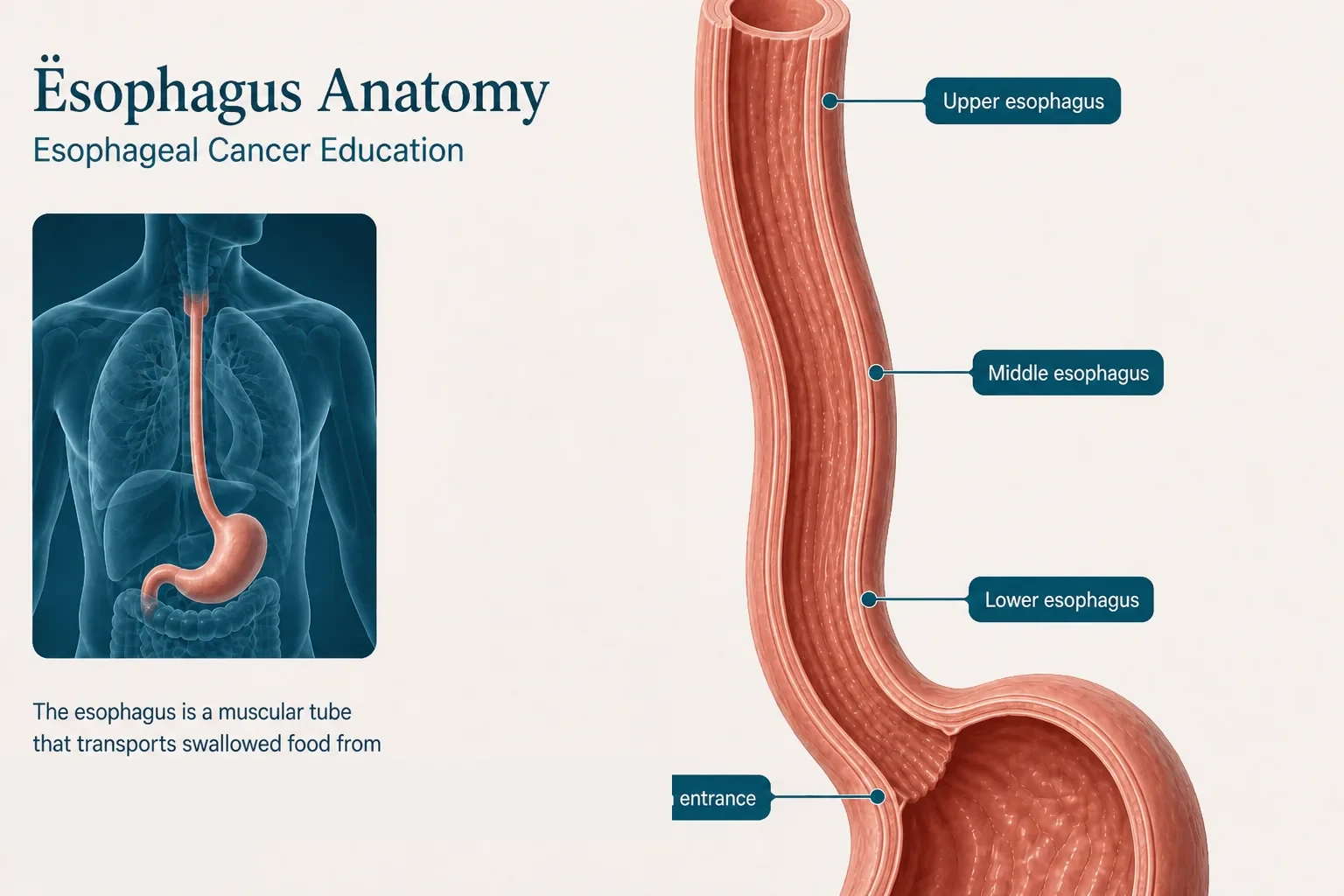
3D educational illustration: esophageal anatomy

How did treatment change?

In esophageal cancer, neoadjuvant / perioperative therapy and immunotherapy have formed a framework separated by histology.

  1. Previous approach

    Surgery or definitive chemoradiotherapy was applied with less personalized sequencing.

  2. New clinical evidence

    CROSS, FLOT / perioperative regimens, and CheckMate studies widened systemic and immune options across squamous / adenocarcinoma distinctions.

  3. Current approach

    Neoadjuvant, perioperative, or definitive pathways are chosen by histology, stage, and surgical fitness; there is no single template.

This summary is for patient education; individual treatment decisions depend on stage, pathology, imaging, and physician assessment.

Landmark status

Sorting

Topic filters

Showing 8 studies.

Comparison table

Select 2 or 3 studies to compare. Different endpoints are never combined in one chart.

Open this discovery in the “Discoveries That Changed Cancer Treatment” hub

Esophageal / gastroesophageal junction cancer

Gold Star — Paradigm-Changing2012 (NEJM); 2015 long-term; 2021 10 -yearSource verified

CROSS

What did the researchers want to learn?

In esophageal cancer that can be operated on, does giving chemotherapy and radiotherapy together before surgery prolong survival?

Before

In many patients, treatment began with surgery alone.

Today

In suitable patients, chemotherapy and radiotherapy can be planned first, followed by surgery.

What did this study change?

In many operable esophageal and gastroesophageal junction cancers, chemoradiotherapy before surgery became a paradigm-changing standard option.

Benefit for patients

Higher likelihood of complete tumor removal at surgery and longer survival.

What did the research find?

NEJM 2012 median overall survival (OS) ~49 vs 24 months; 10-year OS (JCO 2021) 38% vs 25%. Adenocarcinoma and squamous cell results should not be considered identical; CROSS is not a direct comparison with FLOT.

Who does this apply to?

Results are for patients who can be operated on. Histology subgroups are read separately; in adenocarcinoma, the choice of FLOT after ESOPEC is also being discussed.

What did it not prove?

CROSS did not directly compare with perioperative FLOT. It did not show that nonsurgical chemoradiotherapy can replace surgery. The squamous cell subgroup was smaller; the same effect size cannot be assumed for every histology.

Evidence status: Current — confirmed with long-term (10-year) results; in adenocarcinoma, choice is individualized with ESOPEC

This summary is not a treatment recommendation. Decisions depend on the type of disease, stage, general health, and your physician's assessment.

Why this study has a gold star: Made preoperative chemoradiotherapy one of the worldwide standard options for resectable esophageal and gastroesophageal junction cancers. (2012 / 2015 / 2021 · editorial approval 2026-10)

Open this discovery in the “Discoveries That Changed Cancer Treatment” hub

Esophageal adenocarcinoma

Gold Star — Paradigm-Changing2025Source verified

ESOPEC

What did the researchers want to learn?

In esophageal adenocarcinoma, is FLOT chemotherapy given before and after surgery better than chemotherapy plus radiotherapy before surgery (CROSS)?

Before

Preoperative chemoradiotherapy (CROSS) was a common standard option in esophageal adenocarcinoma.

Today

In suitable adenocarcinoma patients, perioperative FLOT emerged as an option with overall survival superiority over CROSS; decisions are made by the multidisciplinary team and according to patient status.

What did this study change?

In resectable esophageal adenocarcinoma, perioperative FLOT became the option showing an overall survival advantage over CROSS; it is not generalized to squamous cell cancer.

Benefit for patients

Likelihood of longer survival in selected adenocarcinoma patients.

What did the research find?

3-year overall survival (OS) 57.4% (FLOT) vs 50.7% (CROSS); hazard ratio (HR) 0.70; median OS ~66 vs ~37 months. It is not generalized to squamous cell esophageal cancer or to all gastric cancers.

Who does this apply to?

Valid only for esophageal adenocarcinoma; it does not address squamous cell carcinoma or the FLOT4 gastric question.

What did it not prove?

Did not show that FLOT is superior to CROSS in squamous cell carcinoma — cannot be generalized to SCC. It is not the same study as FLOT4 in gastric cancer.

Evidence status: Current — choice-changing direct comparison in adenocarcinoma; not SCC

This summary is not a treatment recommendation. Decisions depend on the type of disease, stage, general health, and your physician's assessment.

Why this study has a gold star: Provided strong, direct comparative evidence favoring FLOT in the choice between perioperative FLOT and CROSS for esophageal adenocarcinoma. (2025 · editorial approval 2026-10)

Open this discovery in the “Discoveries That Changed Cancer Treatment” hub

Esophageal / gastroesophageal junction cancer

Gold Star — Paradigm-Changing2021 / DFS; 2025 long-term OSSource verified

CheckMate-577

What did the researchers want to learn?

In patients who had chemoradiotherapy before surgery and still have residual tumor after surgery, does nivolumab delay the return of the disease?

Before

Even with residual tumor, there was no routine additional drug therapy after surgery; patients were observed.

Today

In suitable patients, nivolumab for up to one year after surgery mmo be considered.

What did this study change?

In suitable patients, postoperative nivolumab became the standard option that improves DFS in residual disease.

Benefit for patients

Longer time without disease returning.

What did the research find?

Median disease-free survival (DFS) was 22.4 vs 11.0 months (hazard ratio [HR] 0.69). It applies to the population with neoadjuvant chemoradiotherapy (CRT) + R0 resection + pathological residual disease; it is not automatically generalized to pathological complete response (pCR) or to a different perioperative strategy. The 2025 overall survival (OS) analysis was not statistically significant.

Who does this apply to?

Only for neoadjuvant chemoradiotherapy (CRT) + R0 resection + residual pathological disease. An overall survival advantage was not statistically demonstrated in 2025.

What did it not prove?

Overall survival superiority was not shown statistically in the 2025 long-term analysis. Benefit was not proven in patients with pathologic complete response or those who did not receive chemoradiotherapy.

Evidence status: Current — DFS is the primary evidence; 2025 OS analysis not statistically significant

This summary is not a treatment recommendation. Decisions depend on the type of disease, stage, general health, and your physician's assessment.

Why this study has a gold star: Made adjuvant nivolumab a DFS-based standard option for patients with residual tumor after preoperative chemoradiotherapy. (2021 DFS / 2025 OS NS · editorial approval 2026-10)

Esophageal squamous cell carcinoma

Foundational Evidence2018Source verified

NEOCRTEC5010

What did the researchers want to learn?

In squamous cell esophageal cancer, does giving chemotherapy and radiotherapy before surgery prolong survival?

Before

In squamous cell cancer as well, many centers could proceed directly to surgery.

Today

In resectable patients, preoperative chemoradiotherapy is considered a strong option.

What did this study change?

It is one of the pieces of evidence supporting the option of chemoradiotherapy before surgery in operable squamous cell esophageal cancer.

Benefit for patients

Longer survival and higher complete-resection rates in selected patients.

What did the research find?

Median survival was found to be about 100 months in patients who received treatment before surgery and about 66 months in those who had surgery alone. The proportion of patients in whom the tumor disappeared completely with treatment was 43%.

Who does this apply to?

The study was conducted in China and includes only squamous cell carcinoma; it does not apply to adenocarcinoma. The chemotherapy regimen differs from the one commonly used in other countries.

What did it not prove?

Did not show the result in adenocarcinoma; did not provide a head-to-head superiority comparison with the CROSS regimen. Single-country data.

Evidence status: Current — single-country randomized evidence in squamous cell carcinoma (China)

This summary is not a treatment recommendation. Decisions depend on the type of disease, stage, general health, and your physician's assessment.

Esophageal squamous cell carcinoma

Foundational Evidence2024Source verified

JCOG1109 NExT

What did the researchers want to learn?

In squamous cell esophageal cancer, does adding a third drug or radiotherapy to two-drug chemotherapy before surgery improve survival?

Before

In Japan, preoperative two-drug chemotherapy was the common standard.

Today

In suitable patients, triplet chemotherapy with a third agent (docetaxel) is considered a standard option.

What did this study change?

Three-drug chemotherapy before surgery began to be adopted as a new standard in Japanese patients in suitable general condition.

Benefit for patients

Higher three-year survival rate in selected patients.

What did the research find?

At three years, about 63% of those receiving two-drug chemotherapy were alive, compared with about 72% of those receiving three drugs. In the group with radiotherapy added, the rate was about 68%, and the difference from the two-drug group was not found to be significant.

Who does this apply to?

Results are for patients with squamous cell carcinoma in Japan. This does not mean it replaces CROSS or other approaches in Western countries; it applies to patients who can tolerate intensive chemotherapy.

What did it not prove?

Did not show that preoperative chemoradiotherapy is significantly superior to dual chemotherapy. Did not directly compare triplet chemotherapy with CROSS. Results do not apply to adenocarcinoma.

Evidence status: Current — choice-changing evidence in Japan-centered squamous cell carcinoma

This summary is not a treatment recommendation. Decisions depend on the type of disease, stage, general health, and your physician's assessment.

Open this discovery in the “Discoveries That Changed Cancer Treatment” hub

Advanced esophageal / gastroesophageal junction cancer

Gold Star — Paradigm-Changing2021 (Lancet); 5 -year update 2024Source verified

KEYNOTE-590

What did the researchers want to learn?

In advanced esophageal cancer, does adding pembrolizumab to chemotherapy in first-line treatment prolong survival?

Before

First treatment in advanced disease was chemotherapy alone.

Today

In suitable patients, pembrolizumab can be added to first-line treatment.

What did this study change?

Adding immunotherapy to first-line treatment in advanced-stage patients became a widely used option, depending on PD-L1 and cell type.

Benefit for patients

Longer life and improved five-year survival in some patients.

What did the research find?

Median survival was about 12 months in the group with pembrolizumab added and about 10 months in the chemotherapy-alone group. The proportions of patients alive after five years were 10.6% and 3.0%. The benefit was clearer especially in squamous cell cancers with high PD-L1 levels.

Who does this apply to?

Only for advanced, inoperable or metastatic disease; it should not be confused with adjuvant or neoadjuvant studies in operable disease. PD-L1 level and cell type are important for the decision.

What did it not prove?

Did not show that immunotherapy provides the same benefit to everyone regardless of PD-L1 level or histology. It does not mean the approach applies to resectable early-stage disease.

Evidence status: Current — first-line standard confirmed with 5-year update

This summary is not a treatment recommendation. Decisions depend on the type of disease, stage, general health, and your physician's assessment.

Why this study has a gold star: Made adding immunotherapy to first-line chemotherapy one of the standard options in advanced esophageal cancer. (2021 / 5y 2024 · editorial approval 2026-10)

Open this discovery in the “Discoveries That Changed Cancer Treatment” hub

Advanced esophageal squamous cell carcinoma

Gold Star — Paradigm-Changing2022Source verified

CheckMate-648

What did the researchers want to learn?

In advanced squamous cell esophageal cancer, is first-line nivolumab (with chemotherapy or with ipilimumab) better than chemotherapy alone?

Before

First treatment in advanced squamous cell cancer was chemotherapy alone.

Today

In suitable patients, nivolumab + chemotherapy or (as a separate option) nivolumab + ipilimumab can be considered as first-line treatment.

What did this study change?

In advanced squamous cell cancer, first-line nivolumab plus chemotherapy and nivolumab plus ipilimumab became established as standard options showing an overall survival (OS) advantage over chemotherapy.

Benefit for patients

Longer life in selected patients; regimen choice depends on patient status.

What did the research find?

In patients with a PD-L1 value of 1% or higher, median survival was 15.4 months with nivolumab plus chemotherapy, 13.7 months with nivolumab plus ipilimumab, and 9.1 months with chemotherapy alone. In all patients too, both nivolumab approaches were associated with longer survival than chemotherapy. A significant benefit in time without disease progression was seen especially in the nivolumab plus chemotherapy arm; the two immunotherapy arms were not compared with each other for superiority.

Who does this apply to?

Only for advanced squamous cell carcinoma. PD-L1, general condition and suitability for chemotherapy determine the choice of regimen; for adenocarcinoma, different evidence such as KEYNOTE-590 is used.

What did it not prove?

Did not show benefit in adenocarcinoma. Did not prove that nivolumab + ipilimumab is superior to nivolumab + chemotherapy. The primary PFS significance threshold was not met for nivo+ipi. Does not answer the resectable-disease question.

Evidence status: Current — first-line in squamous cell carcinoma; the two IO arms are read separately

This summary is not a treatment recommendation. Decisions depend on the type of disease, stage, general health, and your physician's assessment.

Why this study has a gold star: Supported both nivolumab + chemotherapy and nivolumab + ipilimumab as first-line options in advanced squamous cell esophageal cancer. (2022 / 5y 2026 · editorial approval 2026-10)

Inoperable esophageal / gastroesophageal junction cancer

Emerging Evidence2026 (ESMO IA2; CT.gov COMPLETED)Study / result verification pending

KEYNOTE-975

What did the researchers want to learn?

Does adding the immunotherapy pembrolizumab to chemotherapy and radiotherapy given without surgery improve disease control?

Before

Adding routine immunotherapy after nonsurgical chemoradiotherapy was not standard.

Today

This trial’s result does not support adding pembrolizumab routinely to definitive chemoradiotherapy; the standard approach did not change.

What did this study change?

It provided no justification for routinely adding pembrolizumab to chemoradiotherapy without surgery; therefore there is no change in practice toward adding pembrolizumab.

Benefit for patients

Because benefit was not shown, no gain was defined that would support routinely adding this drug therapy for patients.

What did the research find?

In patients with a high PD-L1 value (combined positive score [CPS] 10 or higher), median event-free survival was 15.2 months in the pembrolizumab group and 14.7 months in the placebo group; the difference was not significant. No benefit in survival was seen in favor of pembrolizumab either. The study was stopped.

Who does this apply to?

Physician review (again 2026-10-28): There is still no peer-reviewed final results paper — ESMO 2026 congress, interim analysis 2 (IA2). Routine definitive chemoradiotherapy (dCRT) plus pembrolizumab is not supported.

What did it not prove?

Did not prove that adding pembrolizumab to definitive chemoradiotherapy improves EFS or OS; does not support adding pembrolizumab routinely to dCRT. A definitive judgment cannot be made without a peer-reviewed final publication.

Evidence status: Negative interim analysis (ESMO 2026 congress) — peer-reviewed final text pending

This summary is not a treatment recommendation. Decisions depend on the type of disease, stage, general health, and your physician's assessment.

Atlas comparison guide

CROSS – ESOPEC

The question that directly compares preoperative chemoradiotherapy (CROSS) with perioperative FLOT in resectable disease is ESOPEC; ESOPEC is esophageal adenocarcinoma only. CROSS is mostly adenocarcinoma, with some squamous cell carcinoma. The ESOPEC result does not apply to squamous cell carcinoma and is not the same question as the gastric FLOT4 trial.

CROSS – NEOCRTEC5010

Both compare preoperative chemoradiotherapy + surgery with surgery alone, but regimens (carboplatin/paclitaxel + 41.4 Gy vs vinorelbine/cisplatin + 40 Gy) and populations (CROSS mostly adenocarcinoma; NEOCRTEC5010 squamous cell carcinoma from China only) differ. Not a direct head-to-head comparison.

NEOCRTEC5010 – JCOG1109

Both are squamous cell carcinoma but were conducted in China and Japan with different control arms. In JCOG1109, triplet chemotherapy was superior to doublet chemotherapy; the chemoradiotherapy arm did not show a significant difference versus doublet.

CheckMate-577 – preoperative trials

CheckMate-577 asks about adjuvant nivolumab in patients with residual disease after preoperative chemoradiotherapy and R0 surgery; the primary endpoint is DFS. It is not the same as the preoperative treatment question in CROSS, ESOPEC, and NEOCRTEC5010, nor their OS primary outcomes.

KEYNOTE-590 – CheckMate-648

Both are first-line immunotherapy in advanced disease. KEYNOTE-590 includes squamous cell carcinoma and adenocarcinoma together; CheckMate-648 is squamous cell carcinoma only, and the nivolumab + ipilimumab arm is a separate comparison. Agents and subgroups cannot be treated as equivalent.

KEYNOTE-975 – KEYNOTE-590

KEYNOTE-590 showed benefit from adding pembrolizumab to chemotherapy in advanced disease. KEYNOTE-975 reported that adding pembrolizumab to definitive (nonsurgical) chemoradiotherapy did not improve EFS; this is a congress interim analysis, not a peer-reviewed final publication. Results from the two trials cannot be transferred to each other.

Relation to the gastric atlas

MAGIC, FLOT4, MATTERHORN, TOPGEAR, and CheckMate-649 are gastric-atlas trials and are not duplicated as cards here; a cross-index link is used. These trials cover gastric ± gastroesophageal junction adenocarcinoma; they are not a pure thoracic squamous cell cancer question.

Cross-index from the gastric atlas (cards are not duplicated)

The studies below are kept in the gastric landmark atlas. Because of gastroesophageal junction or upper-GI overlap, cards are not recreated here; read the histology and clinical-question note, then open the gastric atlas.

Medical editor's note

Each study was designed for a specific patient group, treatment arm, and primary endpoint. Results should not be automatically generalized to other diseases or to all patients. This atlas is educational and is not a treatment recommendation.

Evidence

Scientific sources

Show sources · 3

Esophageal/GEJ landmark atlas: CROSS, ESOPEC, CheckMate-577, NEOCRTEC5010, JCOG1109, KEYNOTE-590, CheckMate-648; KEYNOTE-975 negative ESMO 2026 congress abstract (not peer-reviewed final). Stomach-atlas GEJ overlaps are cross-indexed. SCC≠adeno; EFS/DFS/OS not interchangeable.

  1. Oesophageal cancer: ESMO Clinical Practice Guideline for diagnosis, treatment and follow-upESMO · 2022 · DOI: 10.1016/j.annonc.2022.07.003Open source
  2. NCCN Guidelines — Esophageal and Esophagogastric Junction CancersNCCN · Current versionOpen source
  3. ESMO Gastrointestinal Cancer GuidelinesESMO · Living / eUpdateOpen source

Source list last checked: 31 October 2026. (Page content review date may appear separately above.)